


Competitor landing-page tear-down methodology for healthcare marketers
A structured methodology for tearing down competitor healthcare landing pages — hook match, proof density, form design, speed — and the failure modes agencies keep misdiagnosing as ad problems.
No pitch. Written root-cause diagnosis. AI-powered, healthcare only.
Direct answer
A structured methodology for tearing down competitor healthcare landing pages — hook match, proof density, form design, speed — and the failure modes agencies keep misdiagnosing as ad problems.
TL;DR
Roughly 60% of Meta ad budget in Indian healthcare leaks at the landing page. A well-crafted ad meeting a weak landing page produces a bad CPQL that looks like an ad problem but is actually a page problem. Every serious competitor teardown has to include the landing page, not just the ad. This guide is the methodology we use inside ICG when we audit a competitor's full funnel — the ad and the page together, because they only make sense as a pair.
The methodology works with any tracking tool. PrismSpy captures landing page snapshots for every ad in the database and retains historical versions when the page changes, which saves the manual click-through work. But the interpretation framework is what actually produces useful reads.

Why landing-page teardown is a separate discipline
Because the failure modes are different. Ads fail on hook, creative, format, and offer. Landing pages fail on match, proof, form, and speed. An ad audit does not catch landing-page failures. A landing-page audit does not catch ad failures. Do both, separately, for a full picture.
The most common misdiagnosis in healthcare Meta marketing: seeing a rising CPQL and blaming ad creative when the actual cause is a landing page that stopped converting after a redesign. If you do not audit the landing page, you cannot see this — you just keep changing ads and watching CPQL not move.
How many landing pages to teardown per competitor
Enough to cover their top 5 unique CTAs. Most healthcare brands run 2-4 landing pages behind their entire Meta ad portfolio — one for lead-form, one for WhatsApp, one for calendar booking, one for phone. Teardown all of them for a top-tier competitor and just the primary one for mid-tier competitors.
Do not teardown every landing page for every competitor. It is expensive time-wise and the marginal insight drops fast after the first 2-3 pages per competitor. The framework matters more than the coverage — a deep read of one competitor's top page beats a shallow read of five.
The four teardown axes (in order)
The four axes below are ordered by importance. A page that fails Axis 1 loses the lead before Axis 2 gets a chance to matter. Work through them in order.
Axis 1: hook match
Does the landing page repeat the ad promise in the first fold? If the ad said "free aligner consultation this week" and the landing page hero says "welcome to our dental clinic", hook match has failed. The lead was warm from the ad and cold by the time they scrolled the page looking for the offer.
The hook-match test is binary. Read the ad copy, then read the landing page hero. Does the hero repeat the promise? Yes or no. If no, the competitor is leaving a huge amount of conversion on the table — note it, learn from it.
Axis 2: proof density
How much healthcare-specific proof does the page show above the fold, and in the first two scrolls? The proof types that matter:
- Doctor byline. Named doctor with photo, specialty, years of practice, and (ideally) a link to their profile.
- Patient count or procedure count. "5,000+ cases", "12 years of practice", "1,200 successful transplants".
- Before-and-after gallery. Photorealistic, well-lit, with treatment named.
- Accreditation logos. NABH, ISO, DCI, MCI, verified specialty association memberships.
- Testimonials. Patient quotes ideally with photo, first name, and treatment named.
Pages with 3+ proof types above the fold consistently outperform pages with 0-1 in the tracked cluster. Note which of these your competitors lead with and which they omit.
Axis 3: form design
The form is where the actual conversion happens. Three failure modes to check:
- Too many fields. More than 4 fields (name, phone, city, treatment) drops conversion meaningfully on mobile. Some competitors run 8-field forms for procedural consultations — usually not by choice, usually because someone in the internal team wanted more data.
- Wrong field types. Free-text city fields (versus dropdown) increase abandonment on mobile. Manual date-of-birth entry (versus picker) similarly.
- Poor mobile behaviour. Fields that trigger the wrong keyboard, forms that scroll oddly, submit buttons that require a stretch tap. Test the competitor's form on your own phone — you will see immediately what works and what does not.
Axis 4: speed and CWV
Google PageSpeed Insights on the competitor's landing page URL. Note the three Core Web Vital scores (LCP, INP, CLS) and the mobile-specific speed score. Pages under 2.5 seconds LCP outperform slower pages, but the delta is smaller than the delta on Axes 1-3 in the healthcare vertical. Speed matters, but hook match matters more.
The teardown template
Fill this in for each competitor landing page you teardown. Ten minutes per page once you have the framework:
| Axis | Observation | Score (1-5) | Note for our brief |
|---|---|---|---|
| Hook match | Does hero repeat ad promise? | ___ | ___ |
| Proof density (above fold) | Count proof types visible | ___ | ___ |
| Form design | Field count, types, mobile behaviour | ___ | ___ |
| Speed / CWV | PageSpeed mobile score | ___ | ___ |
| Overall | What is the biggest gap this page could close? | ___ | ___ |
The last row is the important one. Every teardown should end with a single sentence naming the biggest gap. If you cannot name a gap, either the competitor is running a great page (learn from it) or you did not look hard enough (go back to Axis 1).
The most common Indian healthcare landing-page mistake
Generic homepage as the ad destination. This is by far the biggest and most widespread failure. If a brand spends on Meta ads to promote a specific treatment and the CTA lands on the general "About Us" page, the ad-to-page match is broken and the ad is undervalued by 40-60%. Every ad needs a matched landing page — that is the number-one rule and it is violated constantly.
When you see a competitor doing this, note it. When you see them fixing it (moving from homepage to a treatment-specific landing page), that is a strong signal they are investing in the funnel. When you see them regressing (moving from a specific page back to a homepage), that usually signals internal reorganisation or a page-management problem — worth watching for a follow-up read.
What tools can and cannot help with
 Meta Catalyst IQ long-term comparison view charting Meta Ads performance across quarters with spend, CPQL and volume overlaid" width="1200" height="675" loading="lazy" decoding="async" style="width:100%;height:auto;display:block;">
Tools help with the mechanical side: PageSpeed Insights and GTmetrix for technical audits, PrismSpy for landing-page snapshots and change tracking. Tools do not help with the interpretation side — reading whether hook match is tight, whether proof density is enough, whether the form is right for the specific treatment. That is a human read against the framework above.
The Meta Catalyst IQ product handles the ad-to-page briefing layer downstream. Once you have a teardown, briefing your own landing page against the observed patterns is what closes the loop from intelligence to execution.
Frequently asked
Want ICG to run competitor intelligence on your top 5 competitors? Book a 20-min call →
Book a free 30-minute Brand & Growth Diagnostic.
It's a working session, not a sales pitch — you leave with a written root-cause analysis you can act on, whether or not you engage ICG.
The three platforms
behind every ICG engagement.
Beacon
CAPI middleware that fixes Event Match Quality, translates CRM statuses to Meta-standard events, dedups across channels.
Agency OS
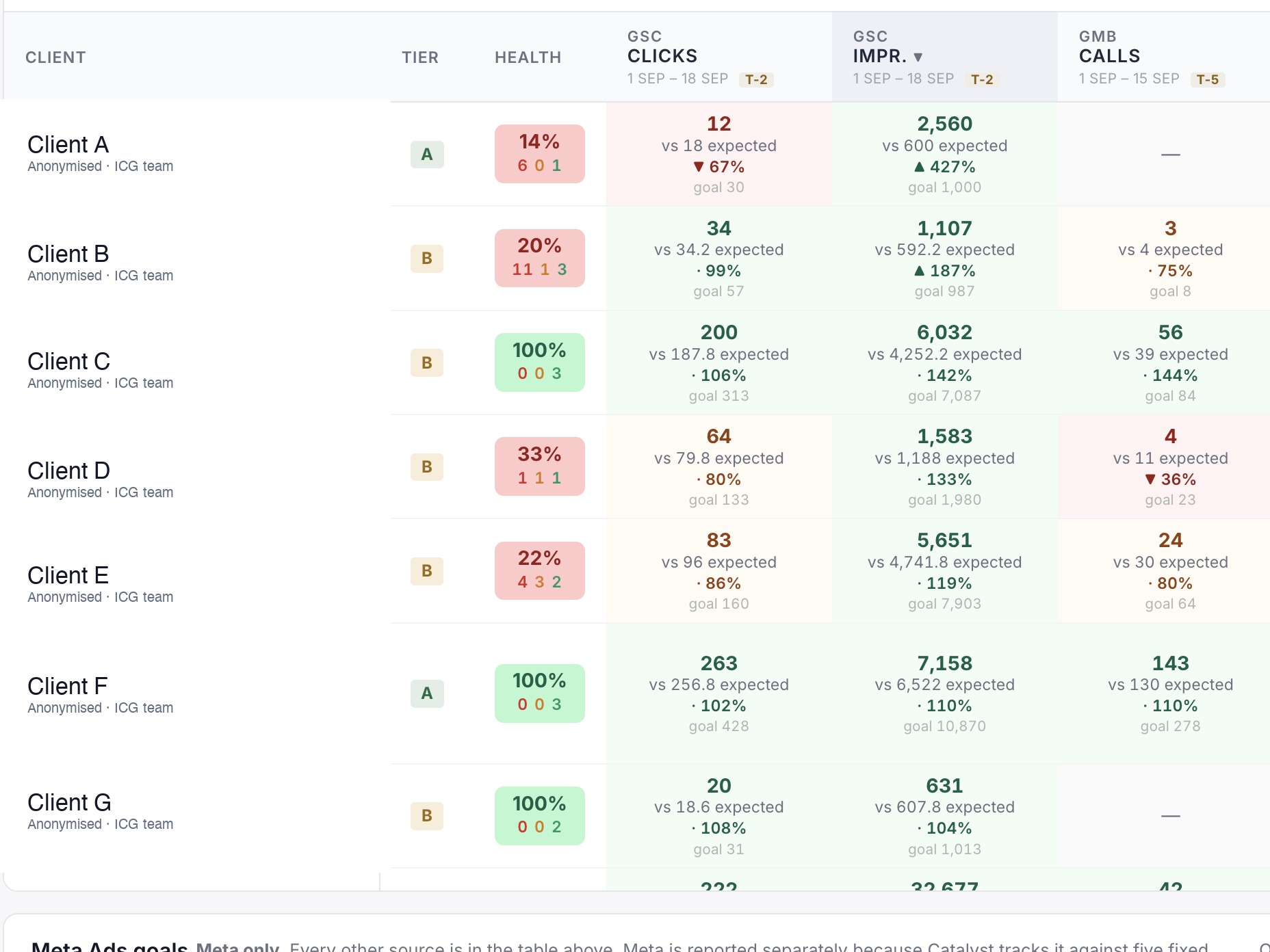
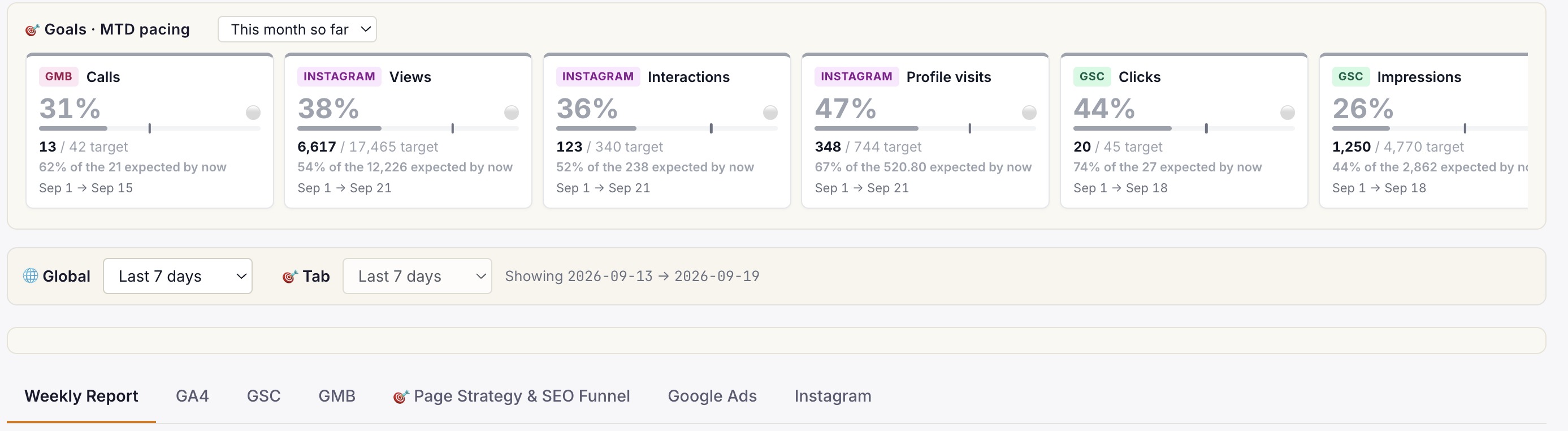
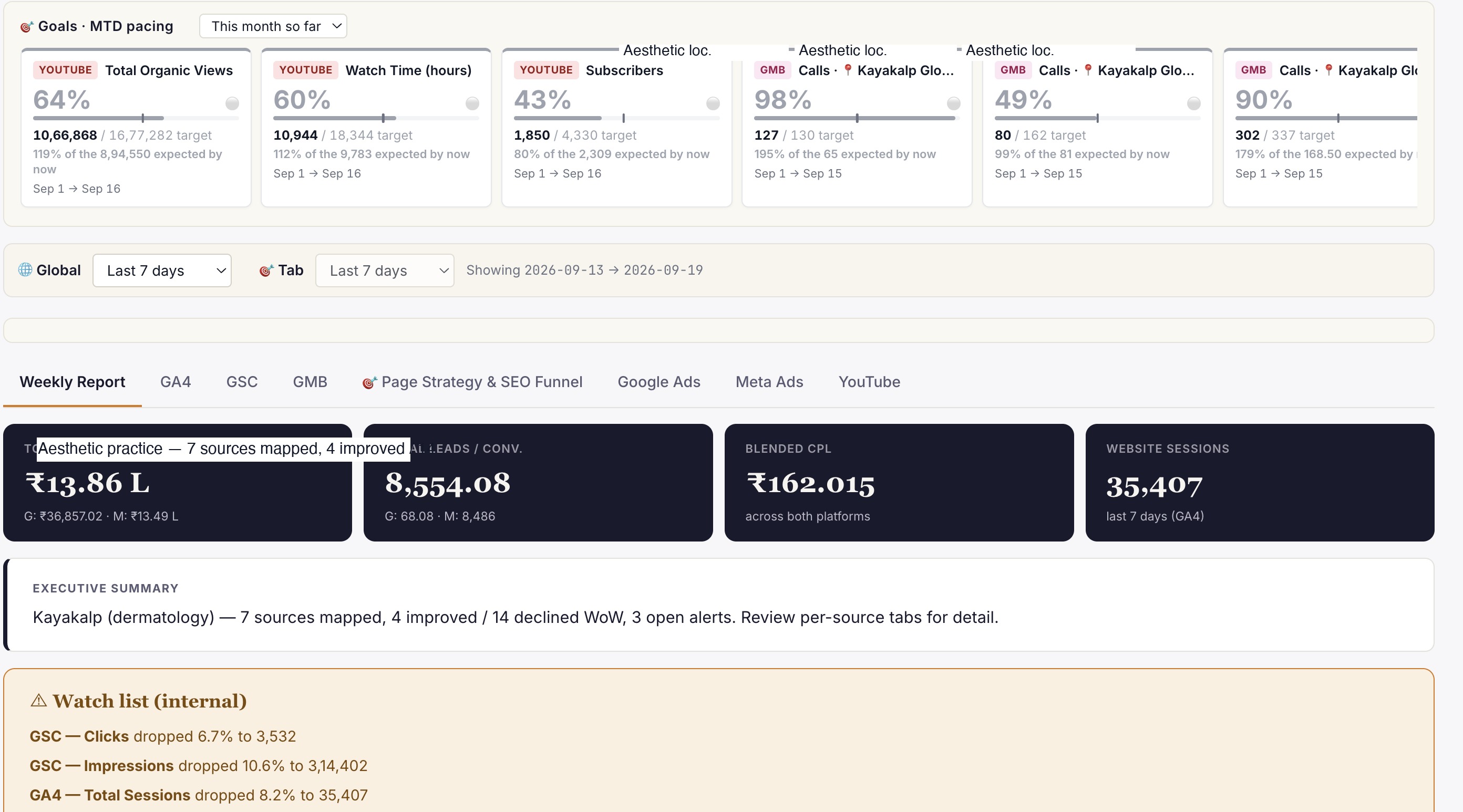
Live client dashboard. GSC, GA4, Google Ads, Meta Ads, IVR calls in one view. Login anytime, not monthly.
Phoenix
Clinic revenue intelligence over your PMS. Daily action queue: Prevent Loss, Maintain & Engage, Grow Revenue. 46-centre rollout.
Or book a free 30-min audit to see all three in action on your account.
Healthcare brands
that already run on ICG.
A representative slice of the 150+ healthcare brands ICG has delivered for across India. Most engagements remain under NDA.


What ICG clients say · on video.
"Scale up of organic channels and business consulting. ICG has absolute domain authority in their field."
"Working with ICG transformed how we acquire IVF patients in Gurgaon. They understand the fertility journey from inquiry to consult..."
"What Ichelon accomplished — they got all my ideas and worked over 3-4 months to create an amazing, super-customised website."
Need help operationalising this?
Every ICG service is healthcare-only, NMC + DPDP-aware, and built around the patient-research patterns that drive Indian healthcare growth in 2026.
Every practice welcome — packages from ₹20,000/mo.
Goal-linked packages · Fixed retainer + Goal-based Variable Pay · 19-month average client retention — industry-leading.
More from
ICG.
Healthcare AIO is the discipline of getting your clinic or hospital cited inside Google AI Overviews, ChatGPT and Perplexity answers — not j...
Conversational-search advertising places brand messages inside AI chat answers — ChatGPT, Perplexity, Copilot — rather than beside a results...
NABH digital compliance means every claim, image and testimonial your hospital publishes online matches what an accreditation surveyor can v...
Stop guessing.
Book a Diagnostic.
30 minutes. Free. With the AI-powered healthcare-only marketing agency 150+ brands already run on. No slides, no pitch, no hard close.


