


Why Every Doctor Should Own Their Google Name Search Result

Why the doctor name-search matters more than clinic marketing
Clinic marketing captures new patients through procedure and location intent — "IVF in Bengaluru", "dermatologist near me". That surface is high-volume and important. But the doctor name-search is where every relationship-based, high-value outcome begins. Referral physicians search names before referring. Board-appointment panels search names before shortlisting. Media reporters search names before quoting. Corporate empanelment buyers search names before contracting. Second-opinion patients search names before booking. Each of these outcomes is worth ₹5-50 lakh over its lifetime. A weak name-search costs them invisibly, one non-referral at a time.
The default state for most Indian doctors' Google name-searches is: a third-party aggregator directory listing at position 1, a hospital-directory or business-directory page at position 2, a LinkedIn profile at 3-4 (if the doctor keeps it updated), possibly a review-site page at 5 (uncontrolled), possibly a news mention at 6-8, and sometimes nothing else. Every one of those is a third-party surface — the doctor does not choose the framing, the photo, or the emphasis. That is where control needs to shift.
The six-surface stack that owns a doctor's name-search
The winning name-search page for a doctor is built from six surfaces, in this order of ranking priority:
A third-party aggregator directory profile is not on this list intentionally. Aggregator profiles are useful for aggregator-search discovery (patients browsing directory sites), but they cannot function as the owned identity surface. They have no analytics, no editorial control, no lead-capture ownership, no sameAs anchor authority.
The Knowledge Panel — how Google decides you exist as an entity
The Knowledge Panel is the boxed information Google shows on the right side of a search result. For a doctor, it typically shows photo, credentials, hospital appointments, published works, and social links. It is generated from an entity graph Google constructs from cross-source signals — the sameAs blocks in Person schema on the doctor's owned website, the LinkedIn profile URL, the ORCID identifier, the hospital-page mention, the Wikidata entry (if it exists), and the Wikipedia article (if it exists).
Doctors with a Knowledge Panel have measurably higher conversion on every downstream touchpoint. Referring physicians report higher confidence. Journalists request quotes at 3-5× the rate. Corporate empanelment buyers shortlist at higher rates. It is the single most-underrated signal a doctor can build. The build path: owned website with Person schema and sameAs array pointing to LinkedIn, YouTube, ORCID, hospital page, Wikidata, Wikipedia. Cross-signal consistency across these surfaces (same photo, same credential order, same name spelling, same date of birth if disclosed) tells Google's entity resolver these all refer to the same person.
The compounding effect over 24 months
The six-surface stack takes 6-12 months to fully establish and 18-24 months to compound to full effect. What that compound looks like:
- Month 3: owned website ranks position 1 for exact name. LinkedIn strengthens to position 3-4. Ambient junk (weak-quality directory listings) starts falling below the fold.
- Month 6: YouTube surfaces populate video-carousel. First media mention published. LinkedIn establishes at position 2-3.
- Month 9: Knowledge Panel begins appearing intermittently. Wikipedia eligibility case starts to build (if applicable).
- Month 12: Full six-surface stack ranking positions 1-6. Knowledge Panel appears reliably. Referral inflow demonstrably improves.
- Month 18-24: Compounding into speaker invitations, board appointments, expert-witness opportunities, high-value second-opinion pipeline.
What breaks after launch — and what to maintain
Owning your name-search is not a one-time build; it is a maintained asset. Common decay patterns:
- Publication list not updated. New journal papers, book chapters, conference talks not added to the website within 30 days of the source event — Google downgrades authority signals over 6-12 months.
- LinkedIn goes silent. Posting cadence drops below once every 3 weeks — LinkedIn algorithm de-prioritises the profile.
- YouTube channel abandoned. Cadence drops below monthly — algorithm de-prioritises new uploads.
- sameAs array broken. LinkedIn URL changed, YouTube handle switched, hospital page moved — entity graph fragments and Knowledge Panel disappears.
- Hospital appointment ended. Old hospital page still shows doctor as current — creates confusion and outdated positioning.
Maintenance cadence: monthly publication + honour update on website, weekly LinkedIn posting, monthly YouTube upload, quarterly sameAs consistency audit, ongoing media-mention outreach.
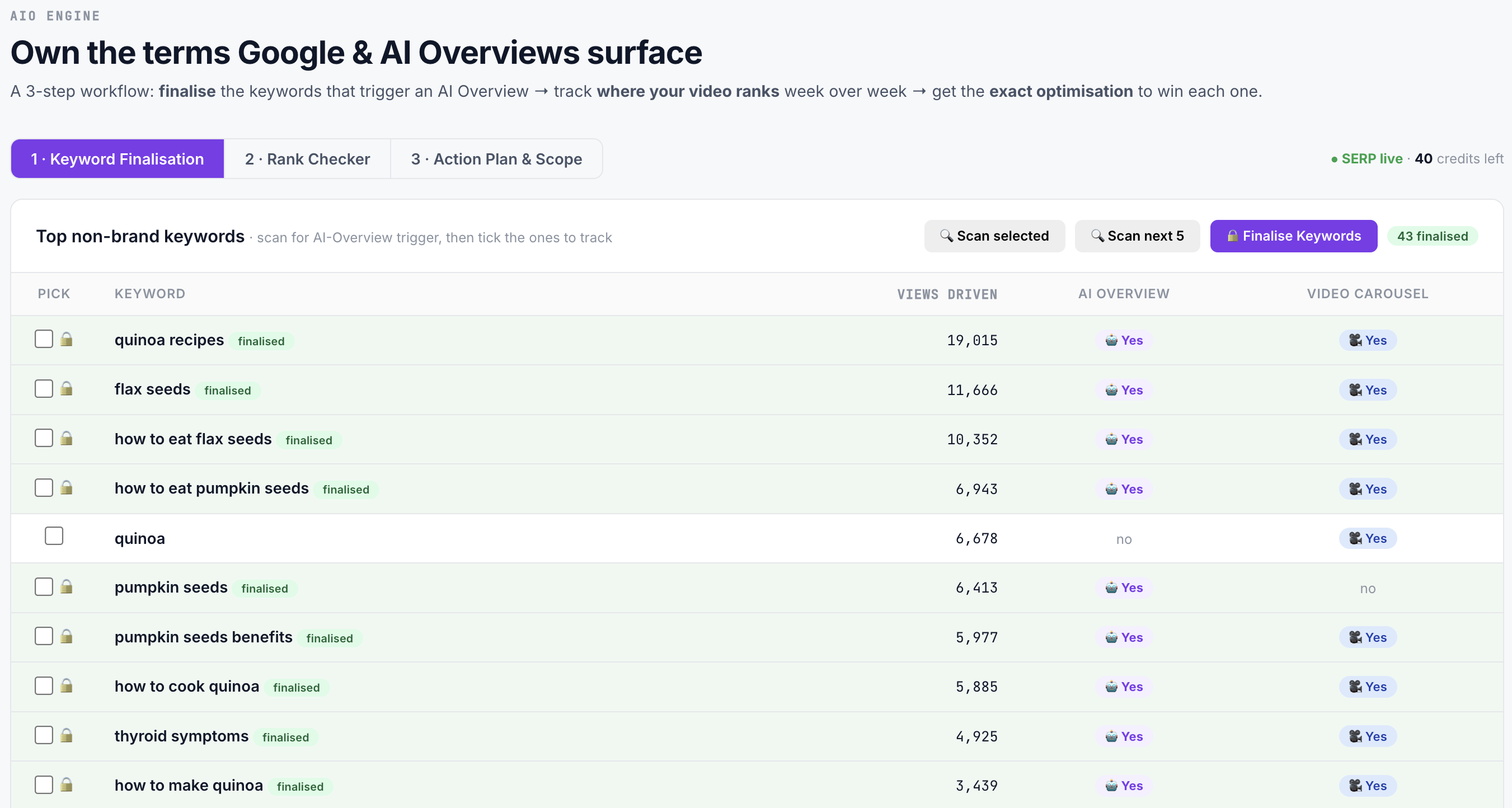
YODA → YODA's AIO Lab tracks which of a doctor's name-search and entity keywords are surfacing inside Google AI Overviews, not just classic blue links.

YODA → Video and content clusters mapped against a doctor's authority topics — the same clustering logic that feeds sameAs and entity-graph consistency.

Angryturtle → Name-Address-Phone consistency across listings is one of the sameAs signals Google's entity resolver checks before it will assemble a Knowledge Panel.
The DoctorBrand engagement structure
ICG's DoctorBrand programme was built specifically to deliver the six-surface stack for named doctors. Three tiers, all custom-scoped, with retainers starting from ₹20,000/month:
- Starter: owned website (6-page architecture), LinkedIn optimisation, GMB + review-management, monthly maintenance. Best for doctors starting from a low ambient baseline.
- Growth: full 10-page owned website architecture, YouTube channel launch and monthly content, LinkedIn thought-leadership cadence, Wikipedia eligibility work, PR outreach, monthly Knowledge Panel signals audit. Best for established doctors building toward speaker + media positioning.
- Scale: all Growth elements plus international-media outreach, expert-witness pipeline, board-appointment positioning, corporate empanelment support. Best for senior consultants building second-decade positioning.
Every engagement starts with a written audit of the doctor's current name-search — the first 20 results, the current Knowledge Panel state, the current sameAs graph, the current LinkedIn/YouTube activity, and the specific gap between the current state and the winning six-surface stack. That audit is delivered before any pricing is confirmed. Zero-obligation.
Related reading, deeper mechanics and services
Component-level detail: how doctors rank for their name on Google (six-surface deep dive), Knowledge Panel doctors India guide, LinkedIn content strategy for doctors, YouTube channel launch guide, doctor personal website setup guide, Wikipedia page for doctors India eligibility. Service page: DoctorBrand service overview.
Get a written name-search audit from ICG — zero-obligation
We audit your current six-surface state, identify the specific gaps, and quote against the closest DoctorBrand tier. No pitch decks, no commitment.
See DoctorBrand programme WhatsApp ICG