


Single Clinic PPC vs Chain PPC in India: A Strategy Comparison
How healthcare PPC splits between single-clinic and multi-location chains in India: account architecture, DPDP consent, NMC-safe copy, per-location CPQL, and budget bands from Rs 25K to Rs 25L a month, with buyer-fit picks for dentistry, derm, IVF and multi-specialty hospitals.
No pitch. Written root-cause diagnosis. AI-powered, healthcare only.
Direct answer
How healthcare PPC splits between single-clinic and multi-location chains in India: account architecture, DPDP consent, NMC-safe copy, per-location CPQL, and budget bands from Rs 25K to Rs 25L a month, with buyer-fit picks for dentistry, derm, IVF and multi-specialty hospitals.
TL;DR
Most Indian healthcare PPC advice online treats every clinic like a single-location dental practice. Wrong starting point for maybe 40% of buyers reading this. A 3-clinic derm chain in Pune, a 12-city IVF group, a 100-bed multi-specialty hospital, and a single-chair dentist in Indiranagar are running four different games — different accounts, different attribution, different landing page maths, different compliance surface.
This guide splits the two ends of that spectrum and lays down the seven axes that decide which setup you need, what it will cost, and what breaks first when you scale.
TL;DR
- Single-clinic PPC is one Google Ads account, one geo-radius, one landing page, one phone line. Attribution is easy. Scale caps around Rs 75,000 to Rs 1,00,000 per month in ad spend before you burn the same 5-km catchment.
- Chain PPC is a network problem. You need an MCC (manager account), shared negative keyword lists, per-location conversion tracking, location-aware ad extensions, and one attribution model that survives multi-touch across 10-100 clinics.
- India-specific constraints — the NMC advertising code, the DPDP Act 2023 consent architecture, ABDM verified-doctor tags — hit chains harder. One non-compliant landing page can trigger disapprovals across every location under the same domain.
- Single-clinic setups usually plateau at 30-60 qualified leads a month. Well-run chain setups clear 500-2,000 qualified leads a month, but only if you have offline conversion imports, per-location CPQL dashboards, and a call-tracking layer that dedupes across brand searches.
- Ad-spend bands in India today: Rs 25,000 to Rs 1L a month for a single clinic, Rs 1-5L a month for a 3-10 clinic cluster, Rs 5-25L a month for a chain. PPC management is priced on a 70-30 fixed-plus-outcome model at the mid and scale tiers.
Table of Contents
- Why this comparison matters for Indian healthcare buyers
- The seven axes that separate single-clinic from chain PPC
- Category comparison at a glance
- Per-axis deep dives
- Which setup fits which buyer
- How ICG approaches this as a neutral advisor
- Pricing reality — the 70-30 model for PPC management
- FAQ
Why this comparison matters for Indian healthcare buyers
Indian healthcare buyers keep landing on the wrong PPC template. A single dentist reads a chain playbook, hires an agency that insists on a full MCC setup and a call-tracking stack costing more than the ad spend itself, and quits paid media in three months. A 40-clinic aesthetics chain does the opposite — runs everything through one flat Google Ads account, cannot tell which centre a lead came from, and blames Google when the CPQL crosses Rs 1,800.
The category error is the same on both sides. Single-clinic PPC and chain PPC are not the same product at two different volumes. They are structurally different — different account architecture, different conversion definitions, different creative supply chain, different reporting cadence, different compliance work under the NMC advertising rules and the DPDP Act.
India adds three constraints that inflate the gap further. First, the NMC Professional Conduct regulations restrict comparative claims, superlatives, and any imagery that could be read as guaranteeing a clinical outcome — the safer copy stack is very different from what a generic PPC template would produce. Second, the DPDP Act 2023 has changed how lead forms are built; consent language, purpose limitation, and grievance officer disclosure now belong on every form that collects a phone number. Third, ABDM verified-doctor status is starting to matter for landing page trust, particularly in cardiology, orthopaedics, IVF, and oncology verticals where high-ticket queries hit the highest CPCs.
All three constraints scale non-linearly with the number of locations. A single clinic can hand-edit its landing page. A 30-clinic chain cannot — one edit gets pushed across 30 URLs, and if that edit is non-compliant, every one of those URLs fails Google's healthcare policy review in the same weekend.
The seven axes that separate single-clinic from chain PPC
Feature-based comparison means judging setups against the same list of axes regardless of vendor. These are the seven that matter in Indian healthcare PPC. Any agency pitch, any in-house build plan, any tool evaluation should score itself against each of them.
- Account architecture — single account vs MCC with per-location sub-accounts; shared negatives; audience libraries.
- Budget allocation and bidding model — flat budget vs per-location caps; Max Conversions vs Target CPA vs Manual CPC; portfolio bidding across locations.
- Landing page strategy — single URL vs one-per-location vs dynamic city-level landing page; page speed; NMC-compliant copy.
- Attribution and conversion tracking — form fills vs call-only vs walk-in matched by offline conversion import; last-click vs data-driven.
- Creative and ad copy supply chain — hand-written per location vs centrally templated with location tokens; extension libraries.
- Geo-targeting and radius strategy — 5-km radius vs pin-code lists vs city-level vs state-level; competing catchment overlap between own locations.
- Compliance layer — NMC advertising code, DPDP Act 2023 consent flows, ABDM verified-doctor tagging, Google Ads healthcare vertical policy.
An eighth axis — reporting cadence and unit economics — sits underneath all seven; you cannot know if any of the above is working without per-location CPQL, cost-per-booked-appointment, and cost-per-first-visit data.
Category comparison at a glance
| Axis | Single-Clinic PPC | Multi-Location Cluster (3-10 clinics) | Chain PPC (10+ locations) |
|---|---|---|---|
| Account architecture | Single Google Ads account; 2-3 campaigns; 1 conversion action set | Single account with per-location campaigns; shared negatives; one MCC optional | MCC mandatory; per-location or per-cluster sub-accounts; shared audience library, shared negatives, brand-vs-non-brand isolation |
| Budget model | One monthly budget, one bidding strategy (typically Max Conversions after 30 conversions) | Per-location cap; portfolio Target CPA; brand pooled, non-brand split | Location-tier budgets (A/B/C by demand); portfolio bidding with per-cluster CPA targets; monthly re-forecast |
| Landing pages | 1-3 pages (service + book + thank-you) | One page per location per service; shared component library | Dynamic city + specialty pages generated from CMS; NMC compliance review baked into publish workflow |
| Attribution | Form fill + call — last click is fine | Form + call + offline conversion import for walk-ins; data-driven attribution | Full offline conversion + CRM-to-Ads sync; per-location cost-per-first-visit; data-driven with 30-day + 60-day windows |
| Creative supply | Hand-written; 4-6 responsive search ads total | Templated with location tokens; 3-4 variants per service per city | Templated + location-aware assets; extension library; AI-generated variants gated by compliance reviewer |
| Geo targeting | 3-7 km radius around the clinic pin | Pin-code lists per location; overlap flagged | Pin-code + city + tier-based targeting; overlap resolution rules; national brand campaign layered on top |
| Compliance layer | Manual NMC + DPDP check per campaign | Central review before publish; DPDP consent copy standardised | Documented policy pack; automated pre-publish scanner; DPDP grievance officer on every form; ABDM tagging where applicable |
| Typical monthly spend | Rs 25,000 - Rs 1,00,000 | Rs 1,00,000 - Rs 5,00,000 | Rs 5,00,000 - Rs 25,00,000+ |
| Reporting cadence | Weekly WhatsApp update | Weekly per-location CPQL + monthly review | Live dashboard + weekly cluster review + monthly board-level unit economics |
Per-axis deep dives
Account architecture — the MCC decision is not optional beyond 6 locations
A single-clinic account rarely needs anything more than one Google Ads login and a clean folder of conversion actions. The moment you cross 3-4 clinics, that flat structure starts hiding money. Non-brand traffic from one city gets budgeted alongside brand queries from another. Bidding strategies that need at least 30 conversions in a 30-day window either starve small locations or eat spend meant for the anchor centre.
By 6-8 locations, you need an MCC (Manager Account). Sub-accounts let each location run its own bidding logic, its own conversion definitions, and its own performance floor. Shared negative keyword lists let you push one edit across the network — a legal update, a competitor name to block, a poorly-performing broad match — in seconds. Shared audience libraries let you build one remarketing pool from the entire chain but activate it per city.
Chains that skip the MCC step almost always run into two failures in year one: they cannot split reporting by location cleanly, and they cannot delegate account access to city marketing managers without giving away the whole network.
Budget allocation and bidding — flat vs portfolio vs location-tier
Single clinics can run Max Conversions once the account has 30-50 conversions in a rolling month. That is often enough. Clusters and chains have to think in portfolios. Some locations are demand-rich (a South Delhi flagship); some are demand-thin (a Tier-2 spoke launched last quarter). Running the same bidding strategy across both wastes budget.
The workable pattern is a three-tier budget: A locations (demand-rich, own the geography, portfolio Target CPA), B locations (growing, Max Conversions with a CPA cap), C locations (new or under-indexed, manual CPC + tight negative lists until you have data). Re-tier every quarter. Do not let a location sit in the wrong tier for six months — that is where most chain PPC leakage happens.
Landing page strategy — one URL, one per location, or dynamic
Single-clinic PPC survives on one hero landing page plus a booking form. Chain PPC does not — every location needs its own URL with the local NAP (name, address, phone), the local doctor panel with ABDM-verified tags where the practice supports it, local reviews, and a location-specific call routing number.
For chains beyond 15 locations, hand-building pages stops working. A dynamic CMS-generated pattern is the standard — one master template, tokens for location name, address, phone, doctor list, service list, timings, and reviews, and a pre-publish compliance scanner that flags NMC-restricted phrases (any word like "best", "world-class", "100% guaranteed", "no side effects", "painless") before the page goes live.
Attribution and conversion tracking — where chains earn back their setup cost
Attribution is where single-clinic and chain PPC diverge most sharply. A single clinic can live with form fills and phone calls as the only conversion signals. Chains cannot. Roughly 30-45% of high-intent healthcare leads in India walk in without a booked appointment, or book via a channel the ad platform never sees (front-desk phone, WhatsApp business number, GBP messages).
To close that gap, chain PPC needs an offline conversion import loop. Every booked appointment gets a GCLID (Google Click ID) captured at form fill or call time, then written back to Google Ads once it converts to a paid consultation. Data-driven attribution then uses that signal to redistribute credit across touch-points — usually pulling budget from generic broad-match campaigns and into the specialty-plus-city clusters that actually produce walk-ins.
Without offline conversion, chains over-invest in cheap-lead clusters that never convert to first visits, and under-invest in the higher-CPC clusters (like IVF or robotic ortho) that actually pay back.
Creative and ad copy — the supply chain problem
A single clinic writes 4-6 responsive search ads by hand. A 30-clinic chain running 8 services needs roughly 240 ad variants before you count seasonal creative or offer variants. Hand-writing that is impossible; leaving Google's AI to generate every variant is a compliance risk under the NMC code.
The middle path most Indian chains use: one master creative library per service, with location tokens for the city, address, phone, and top doctor. Variants are generated centrally, run through a compliance reviewer (either human or a rules-based scanner), then pushed. This is where an in-house paid media pod plus a documented creative brief matters more than which tool you use.
Geo-targeting — radius, pin-code, or city
Single-clinic PPC uses a 3-7 km radius around the pin. Simple. For clusters, radius overlap becomes a problem — two of your own clinics start bidding against each other on the same query in the same catchment. The fix is pin-code list targeting instead of radius, with explicit overlap rules (either one location owns the pin-code, or budgets are prorated by driving distance).
For chains, you layer a national brand campaign on top of pin-code targeting per location. Brand queries route to the closest clinic; non-brand queries stay pinned to city + service clusters. Without this layering, chains routinely spend 20-30% of budget on brand queries getting served the wrong location.
Compliance layer — the axis that quietly kills chain PPC
The NMC advertising rules restrict comparative and superlative claims, prohibit any imagery suggesting guaranteed clinical outcomes, and require honest disclosure of doctor qualifications. Google's healthcare advertising policy runs on top of that and blocks a further list of claims. The DPDP Act 2023 requires clear, purpose-specific consent on every form that collects a phone number, an email, or health data — plus a listed grievance officer and a retention statement.
Single clinics can hand-check every ad and every form. Chains cannot. Beyond 10 locations, you need a policy pack (a documented list of banned words, mandatory consent language, mandatory disclosures) and a pre-publish scanner that runs against every new landing page and ad. Every ICG chain client runs both — because a single non-compliant page can trigger a domain-wide Google policy strike that pulls every location's ads down for 48-96 hours during review.
Which setup fits which buyer
Single dental clinic in Indiranagar (1 chair, 1 dentist, Rs 8-12L monthly revenue)
Single-clinic PPC only. Budget band Rs 25,000-60,000 per month, split roughly 70% Google Search on high-intent queries (root canal, dental implants, wisdom tooth removal near me) and 30% Meta Ads for offer-led remarketing. One landing page per top service. One WhatsApp number for lead capture with DPDP-compliant consent copy. Weekly reporting cadence. Ignore MCC. Ignore offline conversion imports until you cross 60 leads a month.
3-clinic dermatology group in Pune (Rs 1.5-2.5 Cr annual revenue)
Cluster setup. Single Google Ads account with three location-specific campaigns; shared negative list; per-location call tracking numbers; three landing pages (one per clinic) with shared component library. Budget Rs 1.5-3L per month. Introduce offline conversion import in month three once the CRM is clean. Add a fourth "brand" campaign that routes to the closest clinic based on user location. Add Meta Ads for aesthetic/laser services once search is stable.
12-city IVF chain (Rs 40-60 Cr annual revenue)
Full chain PPC setup. MCC with per-city sub-accounts. Dynamic city-plus-service landing pages generated from CMS. Compliance scanner on publish. Offline conversion import mandatory — IVF consideration windows run 60-120 days, and without offline conversion the account cannot distinguish a Rs 800 form-fill lead from a Rs 40,000 first-consult booking. Portfolio bidding with per-city CPA targets. Budget Rs 8-15L per month across paid search plus a further Rs 3-6L on YouTube for education-stage traffic. Weekly per-location dashboards. Monthly board-level cost-per-first-visit reporting.
100-bed multi-specialty hospital in Faridabad (cardiology + ortho heavy)
Hybrid. Single location, but multi-specialty behaves like a mini-chain because each specialty has its own funnel, CPC, and lead-quality profile. Sub-accounts per specialty (cardiology, orthopaedics, general surgery, emergency), shared brand campaign at the top. Landing pages built per specialty with the local doctor panel and empanelled insurance list. Offline conversion mandatory to attribute inpatient admissions back to paid touch-points. Budget Rs 3-6L per month across paid search, plus TPA/insurance-audience remarketing on Meta.
How ICG approaches this as a neutral advisor
ICG runs paid media for 150+ clinics and 300+ live healthcare clients across India. That volume forces a feature-based lens — we do not have a favourite call-tracking tool, a preferred landing page platform, or an anchor CRM. What we have is a documented playbook per buyer tier: account architecture, conversion definitions, compliance pack, reporting cadence, CPQL floor.
Single-clinic engagements start with a two-week diagnostic — GBP health, account audit, competitor spend estimation (via our internal Prism Spy Meta Ads intel), and a 90-day CPQL forecast. Chain engagements begin with a compliance and architecture audit — MCC structure, per-location tracking, DPDP consent flow, NMC copy review, landing page inventory. Only after that do we quote a scope.
Where products help, they help. Angryturtle handles the GBP layer most paid-search accounts leak leads to. YODA feeds YouTube traffic into paid-search remarketing pools. Meta Catalyst IQ runs the Meta side and syncs audiences back to Google Ads. Nexus CRM (Rs 14,999/month) and HealthPro 360 (Rs 14,999/month) close the offline conversion loop via GCLID capture. None of that is mandatory — clients keep their existing stack and we integrate to it.
Pricing reality — the 70-30 model for PPC management
ICG prices paid media on the same 70-30 model we use for SEO — 70% fixed retainer, 30% tied to a 12-month performance target on a sliding scale. Fixed retainer bands for paid search management start at Foundation (Rs 49,999/month, single clinic or two-clinic cluster, ad spend up to Rs 1.5L), Growth (Rs 74,999/month, 3-8 clinics, ad spend Rs 1.5-5L), and Scale (Rs 99,999/month plus percentage-of-spend above Rs 5L). Google Ads engagements above Rs 5L monthly spend and Meta engagements above Rs 3L monthly spend move to hybrid retainer-plus-percentage — the fixed component covers strategy, compliance, reporting, and account architecture; the variable component covers execution scale.
The outcome-tied 30% ties to an agreed CPQL and volume floor set at kickoff. If we hit both, the full 30% releases. If we miss, we bill the fixed only. This makes sense in healthcare paid media specifically because CPQL and lead volume are the only two numbers that actually move first-visit revenue — everything else is either an input (CTR, quality score) or a distraction (impression share, view-through conversions).
FAQ
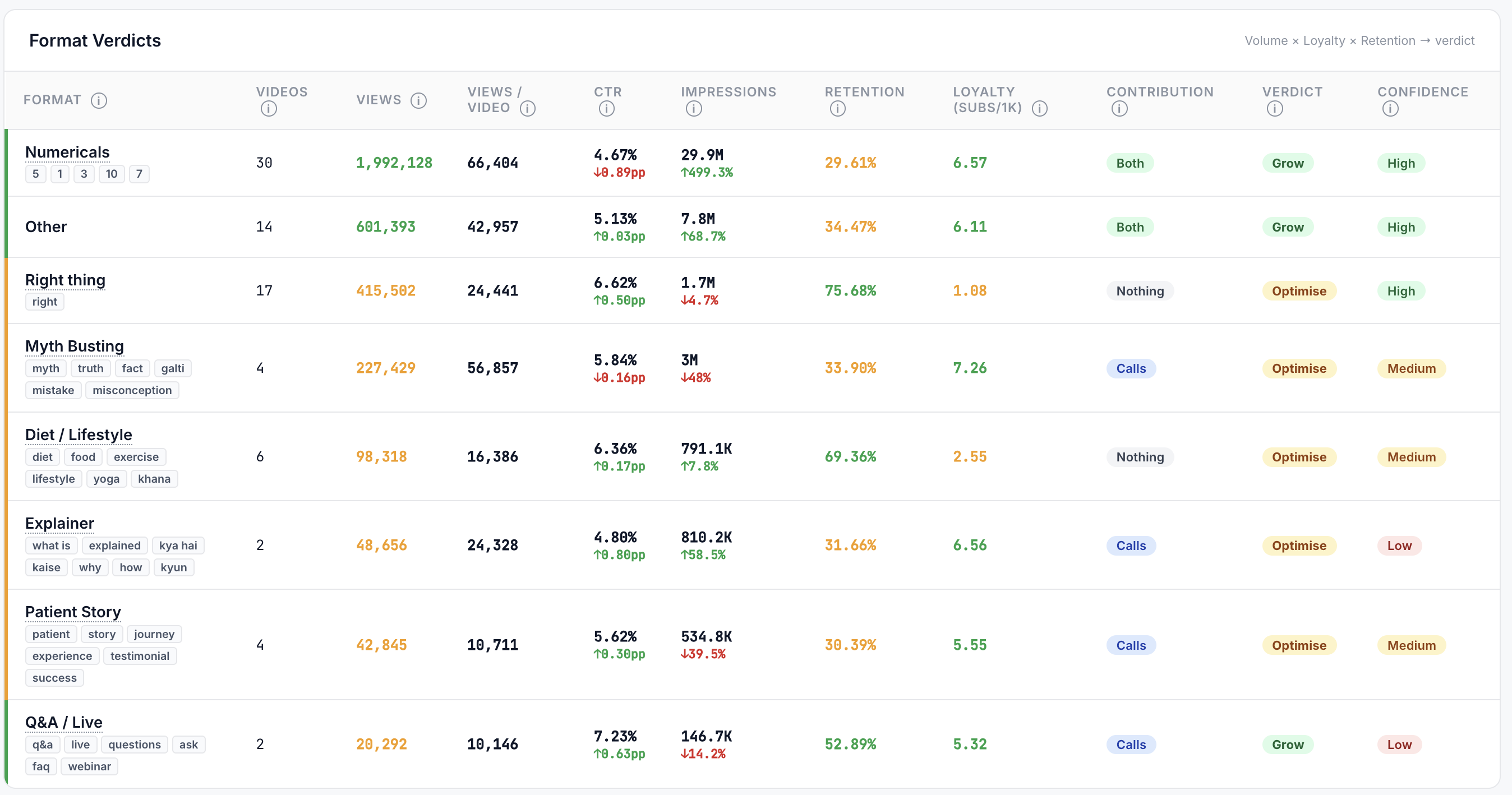
 Meta Catalyst IQ Master Dashboard showing account-level KPIs, spend, CPQL and campaign health for a healthcare Meta Ads account" width="1200" height="675" loading="lazy" decoding="async" style="width:100%;height:auto;display:block;">

Should a single dental clinic run Google Ads or just Google Business Profile?
Both, in that order. GBP optimisation (photos, categories, reviews, weekly posts, direct-call button, service list) will produce more leads per rupee than Google Ads for a single-clinic setup with a strong 5-km catchment. Add Google Ads when you have exhausted GBP-driven demand — typically 30-40 leads a month — and want to push CPQL down further or expand into a bigger radius.
What is the minimum monthly ad spend to justify a chain PPC setup?
Roughly Rs 1.5L per month across at least three locations. Below that, per-location conversion volume is too thin for portfolio bidding to work, and the MCC overhead is not paid back by attribution gains. Below Rs 1.5L, run each location as an individual account with shared reporting.
How do we structure PPC for a hospital with cardiology, ortho, and IVF under one brand?
Treat each specialty as if it were a separate location. One brand campaign at the top for direct branded queries, then sub-accounts (or at minimum distinct campaign clusters) per specialty. Each specialty gets its own landing page, its own doctor panel, its own conversion floor, and its own bidding strategy. Do not run cardiology and general dermatology under the same Target CPA — the CPC differential will silently starve the higher-value specialty.
Is call-only or landing-page bidding better for clinics in India?
Call-only wins for urgent-care and general-consult keywords in Tier-1 metros; landing page wins for considered-purchase specialties like IVF, dental implants, robotic ortho, aesthetics. A hybrid setup is common — call-only for the branded and near-me queries, landing page for the specialty and treatment queries. Test the split by device: mobile leans call, desktop leans landing page.
How does the DPDP Act 2023 change PPC lead forms?
Every form that collects a phone number, email, or health data now needs specific-purpose consent language (not a generic terms-of-use checkbox), a stated data retention period, and a listed grievance officer with contact details. Consent must be freely given and easy to withdraw. Practically, that means updating every landing page form, every WhatsApp opt-in, and every offline booking form — and documenting the consent record per lead so you can produce it on request.
Should each clinic in a chain have its own Google Ads account?
No — that fragments negative keyword sharing, audience libraries, and reporting. The correct pattern is an MCC (Manager Account) with per-location sub-accounts. Sub-accounts give each location autonomy on bidding and budget while the MCC keeps shared assets shared. City marketing managers can be given access only to their sub-account without seeing the rest of the network.
What conversion window works for high-consideration treatments like IVF or ortho?
60 to 120 days for IVF; 30 to 60 days for ortho and cardiology. The default 30-day window in Google Ads under-attributes both. Extend the conversion window inside the conversion action settings, and pair it with offline conversion imports so that the eventual paid consultation is credited back to the original ad click — otherwise data-driven attribution will keep pulling budget toward faster-converting but lower-value queries.
How much does chain PPC management cost in India in 2026?
Fixed retainer bands run Rs 49,999/month (single clinic or two-clinic cluster) to Rs 99,999/month (chain baseline), plus a percentage-of-spend layer above Rs 5L monthly ad spend. Under the 70-30 model, 30% of the retainer is tied to an agreed CPQL and volume target. Ad spend runs Rs 5-25L per month depending on specialty mix.
Do we need offline conversion import from day one?
For single clinics, no. For clusters of three or more locations or for any specialty with a consideration window beyond 30 days, yes — from month two or three, once the CRM is clean enough to be trusted. Without offline conversion, chain PPC over-optimises for cheap form fills and under-invests in the paid consultation queries that actually pay back.
Next step. Single clinic — start with a GBP-plus-single-account audit. Cluster or chain — start with a compliance-and-architecture audit before any spend goes on. Book a 30-minute diagnostic with the ICG paid media team; we will map your setup against the seven axes and produce a written 90-day plan with CPQL forecasts.
Book a free Google Ads account audit.
Raman Soni's team pulls your account, reviews campaign structure, keyword intent tiering, landing pages, and CPQL attribution. 45 minutes, actionable.
Questions readers ask
about this topic.
The three platforms
behind every ICG engagement.
Beacon
CAPI middleware that fixes Event Match Quality, translates CRM statuses to Meta-standard events, dedups across channels.
Agency OS
Live client dashboard. GSC, GA4, Google Ads, Meta Ads, IVR calls in one view. Login anytime, not monthly.
Phoenix
Clinic revenue intelligence over your PMS. Daily action queue: Prevent Loss, Maintain & Engage, Grow Revenue. 46-centre rollout.
Or book a free 30-min audit to see all three in action on your account.
Healthcare brands
that already run on ICG.
A representative slice of the 150+ healthcare brands ICG has delivered for across India. Most engagements remain under NDA.


What ICG clients say · on video.
"Scale up of organic channels and business consulting. ICG has absolute domain authority in their field."
"Working with ICG transformed how we acquire IVF patients in Gurgaon. They understand the fertility journey from inquiry to consult..."
"What Ichelon accomplished — they got all my ideas and worked over 3-4 months to create an amazing, super-customised website."
Need help operationalising this?
Every ICG service is healthcare-only, NMC + DPDP-aware, and built around the patient-research patterns that drive Indian healthcare growth in 2026.
More from
ICG.
Healthcare AIO is the discipline of getting your clinic or hospital cited inside Google AI Overviews, ChatGPT and Perplexity answers — not j...
Conversational-search advertising places brand messages inside AI chat answers — ChatGPT, Perplexity, Copilot — rather than beside a results...
NABH digital compliance means every claim, image and testimonial your hospital publishes online matches what an accreditation surveyor can v...
Stop guessing.
Book a Diagnostic.
30 minutes. Free. With the AI-powered healthcare-only marketing agency 150+ brands already run on. No slides, no pitch, no hard close.


