


Local Pack Ranking for Medical Clinics in India: The Complete 2026 Playbook
The Google local pack drives 60 to 70 percent of first-touch inquiries for Indian medical clinics. Here is how ranking actually works, the five mistakes we see in 8 out of 10 GBP audits, and the weekly cadence that moves clinics from rank 7 to rank 2 inside 6 weeks.
No pitch. Written root-cause diagnosis. AI-powered, healthcare only.
Direct answer
The Google local pack drives 60 to 70 percent of first-touch inquiries for Indian medical clinics. Here is how ranking actually works, the five mistakes we see in 8 out of 10 GBP audits, and the weekly cadence that moves clinics from rank 7 to rank 2 inside 6 weeks.
TL;DR
TL;DR
- The Google local pack, the map plus three clinic listings that sit above organic results, drives 60 to 70 percent of first-touch inquiries for Indian medical practices on searches like "IVF clinic in Gurgaon" or "dentist near me".
- Google decides the 3-pack using proximity, relevance, and prominence. Prominence is the one lever most Indian clinics ignore, and it is also the one that compounds over 12 to 18 months.
- A new Google Business Profile typically enters the 3-pack in 90 to 180 days if reviews, categories, and on-page location signals are worked weekly, not monthly.
- In 8 of every 10 clinic GBP audits we run at ICG, the primary category is set wrong (Hospital instead of Fertility Clinic, say) and the service pages are too thin for Google to bind them to a city.
Table of Contents
- Why the local pack decides footfall for Indian clinics
- What actually is the local pack, and how is it different from Google Maps?
- How does Google rank medical clinics in the local 3-pack?
- Which Google Business Profile signals move the needle most?
- How do patient reviews influence local pack ranking?
- What are the biggest local SEO mistakes Indian clinics make?
- How should a multi-location hospital chain structure local SEO?
- How long does it take an Indian clinic to break into the local pack?
- How ICG runs local pack campaigns differently
- What does a local SEO retainer cost in India?
- Frequently asked questions
Why the local pack decides footfall for Indian clinics
Search behaviour in Indian healthcare is intent-heavy and location-locked. A parent hunting for a paediatrician in Whitefield does not scroll to the eighth blue link. She taps the first map card she sees, checks the star rating, glances at the two most recent reviews, and either calls or requests directions. That single interaction happens millions of times a day across Indian cities, and Google's own India query data shows that "near me" style health searches have grown at roughly 40 percent year on year since 2022.
For a hospital marketing director, the practical impact is blunt. If your clinic is not sitting in the local 3-pack for the specialty-plus-city terms you care about, most of your paid effort on Meta and YouTube ends up nudging patients who then Google you and find a competing clinic sitting higher on the map. The local pack is the ceiling of the funnel for most Indian clinics under 50 beds. This is also why the Ayushman Bharat Digital Mission (ABDM) push to formalise clinic identities makes local pack real estate more contested every quarter, not less.
What actually is the local pack, and how is it different from Google Maps?
The local pack is the map-plus-three-listings block that Google inserts near the top of a search results page whenever it detects local intent. It pulls from the same Google Business Profile index that powers Google Maps, but the pack is a curated slice. Google shows only three clinics, chosen fresh for each query, based on where the user is standing and what they typed.
Maps is the full directory. The local pack is the shortlist. For an Indian clinic, ranking in Maps is table stakes; ranking in the pack is the actual game. A patient searching from a Kochi PIN code for "orthopedic hospital" is served three Kochi options, not a Bengaluru chain, even if the Bengaluru chain has better reviews overall.
How does Google rank medical clinics in the local 3-pack?
Google uses three ranking factors that its own documentation names openly: proximity, relevance, and prominence. For a clinic in India, the weighting sits roughly at 40 percent proximity, 30 percent relevance, and 30 percent prominence, with prominence rising sharply for competitive metro categories like Delhi cosmetic surgery or Mumbai IVF.
Proximity is how close the searcher is to your clinic when they search. You cannot change this. But you can influence which geographies you are eligible to serve by opening satellite locations, adding service-area attributes, and picking the right primary category.
Relevance is how well your GBP and its linked landing page match the query. This is the layer where category depth, service list, business description keywords, and the landing page you point the profile at all matter.
Prominence is how well-known your clinic looks to Google. It is measured through reviews, citations across Indian directories, mentions in local news, backlinks from health portals, and the strength of the domain your GBP is linked to.
Which Google Business Profile signals move the needle most?
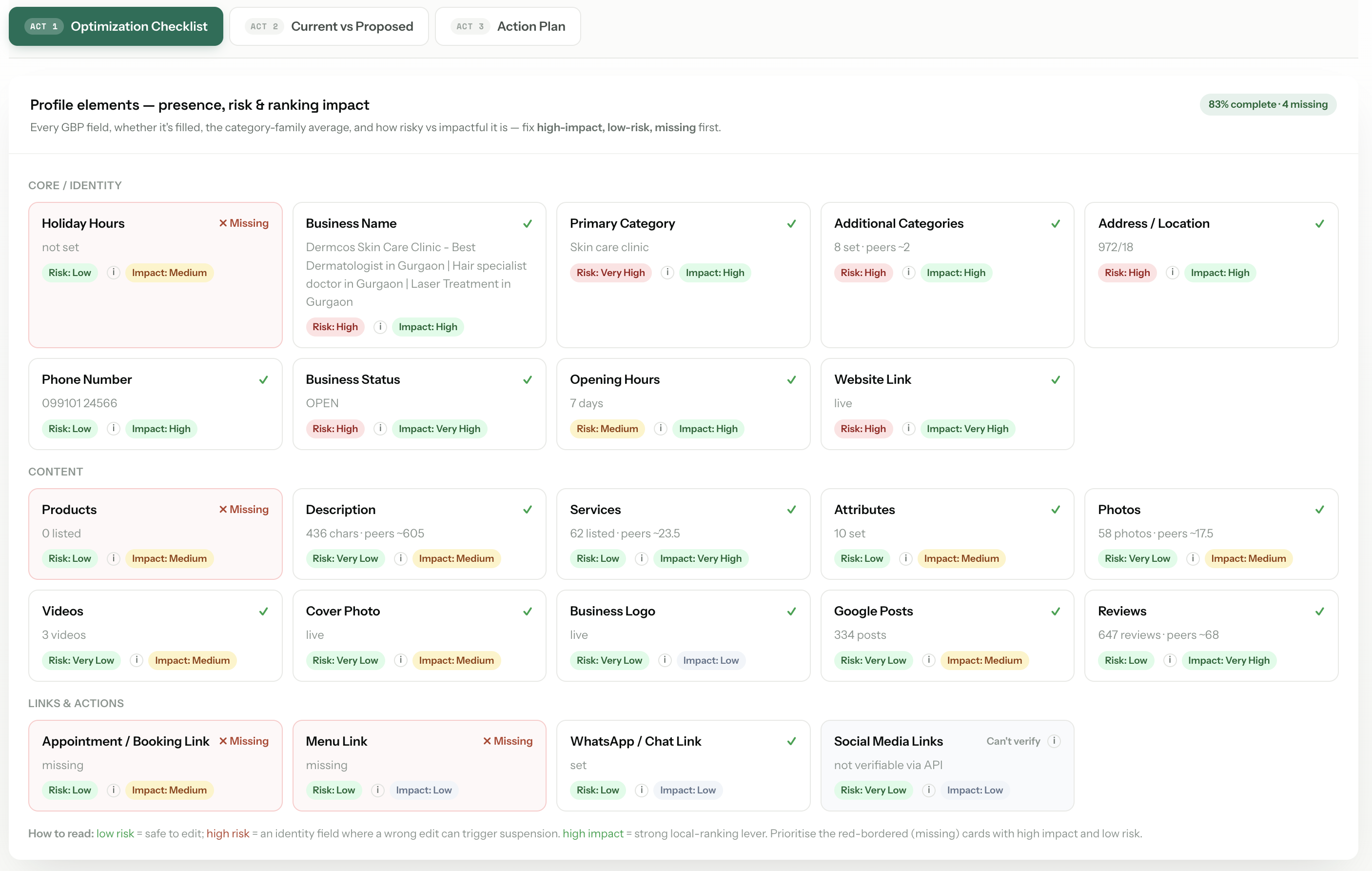
The signals we consistently see move rankings for clinics under our management are, in order of impact: primary category, secondary categories, review velocity, review response rate, geo-tagged photos uploaded weekly, opening hours accuracy, and product-and-service list depth. In that order.
The single most abused field is primary category. A fertility clinic in Hyderabad we onboarded in early 2026 had "Hospital" set as its primary category. Its actual specialty was IVF. Switching primary category to "Fertility Clinic" and pushing "Hospital" to secondary moved the profile from rank 7 to rank 2 in the local pack for its top three IVF queries, inside 6 weeks, with no other change made.
Product-and-service lists are the other underused surface. Each service entry (say, "Frozen Embryo Transfer" or "IUI Consultation") acts like a mini keyword page inside GBP. A clinic with 25 well-written service entries almost always outranks one with 5, category for category. Photos matter too. Profiles with fresh geo-tagged photos uploaded every week rank measurably higher because Google reads the upload cadence as an activity signal, roughly the same way it reads posting cadence.
How do patient reviews influence local pack ranking?
Reviews influence local pack ranking on four dimensions: total count, star average, review velocity (fresh reviews per month), and keyword mix inside the review text. Response rate, whether the clinic replies to reviews within a few days, is a secondary but measurable signal.
Our own client data across 90 Indian clinics we track weekly shows the top three ranked profiles in any given city-specialty search average 214 reviews, versus 47 for profiles ranked 4 to 10. The gap widens further for the top position. Profiles at rank 1 pull an average of 8 to 12 new reviews per month, while stalled profiles at rank 4-plus pull under 2.
Review keyword mix is the quiet lever. When patients naturally mention "root canal", "braces", "Invisalign", or "wisdom tooth extraction" inside their review text, that text is indexed by Google and used as a relevance signal. This is why a well-briefed reception team, one that gently reminds patients to mention the treatment they had, moves rankings faster than a generic "please leave a review" QR code at the billing counter.
A note on Indian regulation. The National Medical Commission's advertising code prevents registered doctors from soliciting or paying for testimonials. Asking a patient to leave an honest review is fine. Offering a discount for a review is not, and can jeopardise a doctor's registration under the 2022 NMC Registered Medical Practitioner regulations. The DPDP Act, 2023, further restricts how patient contact details can be used for review requests, which is why we route all outreach through an opt-in the patient signs at check-out. Angryturtle, ICG's GBP operating system, builds these compliant review-request flows into the post-visit journey without ever crossing that line.
What are the biggest local SEO mistakes Indian clinics make?
Five mistakes come up across almost every one of the 150-plus clinic audits our team has run in the last 18 months:
- Wrong primary category. "Hospital" or "Medical Clinic" set when a specialty category (Fertility Clinic, Dental Clinic, Dermatologist) is available. Costs 3 to 5 rank positions.
- NAP inconsistency. Name, Address, Phone written differently across your website, GBP, and various local business directories. Even a "Dr" versus "Doctor" difference can confuse Google's entity-matching.
- Service pages that are too thin. A 250-word page titled "IVF Treatment" cannot rank for "IVF clinic in Powai". The page needs to name the neighbourhood, price band, doctor bio, before-and-after markers, and 8 to 12 patient FAQs.
- No location page per branch. A chain with 6 clinics in NCR runs a single "Contact Us" page listing all six. Every branch needs its own indexable URL with unique content, embedded map, and branch-specific reviews.
- Ignoring photos and Q&A. Clinics upload 8 photos at launch and then never again. The GBP Q&A section is also left un-answered, which is a wasted signal because Google treats consistent Q&A activity as engagement.
How should a multi-location hospital chain structure local SEO?
A multi-branch hospital chain needs one GBP per physical location, one dedicated location page per branch on the website, and a centralised review-management layer that lets marketing HQ see reviews across all branches in a single dashboard. Anything less loses proximity signals and creates duplicate-content risk.
The structural choice most hospital chains get wrong is trying to run all branch inquiries through a single central number. Google's proximity algorithm rewards branch-specific phone numbers because it reads them as branch legitimacy. Central IVR numbers, especially those with 1800 prefixes, dilute proximity scoring in some categories.
Location pages should follow a repeatable template. H1 with clinic name plus city plus specialty. Embedded Google Map. List of consultants at that branch with headshots. Branch-specific FAQs about parking and Metro access. Insurance-empanelment list. And the three or four services the branch is most known for. Our team runs this template for a Bengaluru multispecialty chain across 11 branches. Branch-level organic traffic doubled inside 7 months.
How long does it take an Indian clinic to break into the local pack?
A new Google Business Profile with no history typically breaks into the local 3-pack for at least one high-intent query within 90 to 180 days, provided reviews, categories, and location signals are worked weekly. Established profiles that are stuck at rank 4 to 10 usually move to top 3 inside 60 to 120 days once the diagnostic fixes are applied.
The clinics that do not move are the ones running local SEO as a monthly retainer of "5 posts and 5 reviews". Local SEO is a weekly cadence. Post daily. Ask every satisfied patient for a review the same evening. Upload two photos. Respond to every question in the GBP Q&A within 24 hours. It is boring, and it works.
How ICG runs local pack campaigns differently
ICG's local pack work runs on Angryturtle, our proprietary GBP operating system, layered with Prism Spy for competitor Meta Ads intelligence and Prism Pulse for Instagram analytics. Angryturtle handles the operational grind, daily posts, review requests, photo uploads, Q&A monitoring, category audits, citation cleanup across Indian directories, while our SEO team runs the strategic layer of category depth, on-page location signals, and review keyword briefings for the reception team.
For clinics that also need a CRM to route the leads the local pack generates, we plug in Nexus CRM at Rs 14,999/month or, for hospitals that need an RCM plus EHR overlay, HealthPro 360 at Rs 14,999/month. YODA, our AI-native YouTube system, handles the doctor-authority layer, which in turn feeds review keyword mentions and branded-search queries, and both of those reinforce local pack prominence. Meta Catalyst IQ, our Meta Ads engine, keeps paid traffic pointed at the same landing pages the GBP is linked to, so both channels compound on the same ranking signals instead of pulling against each other.
We do not run local SEO as a monthly checkbox. We run it as a weekly cadence with weekly ranking reports, benchmarked against the three nearest competitor GBPs Google shows for the client's top 25 queries.
What does a local SEO retainer cost in India?
ICG's healthcare SEO retainers use a 70-30 fixed-plus-variable model. The fixed portion covers the weekly local SEO grind and the strategic layer. The variable 30 percent is tied to a 12-month traffic-and-lead target on a sliding-scale slab, so we win when the clinic wins. Foundation starts at Rs 49,999/month, Growth at Rs 74,999/month, and Scale at Rs 99,999/month.
Local pack work sits inside all three tiers, with weekly cadence at Growth and Scale and fortnightly cadence at Foundation. For clinics with 5-plus branches, we typically recommend Scale, because each branch needs its own GBP cadence and the workload scales roughly linearly with location count. If Google Ads or YouTube SEO also come into the mix, the 70-30 model extends to those channels too, at their own base commitments (Rs 5 lakh+ monthly ad spend for Google/Meta ads management, Rs 50,000+ for YouTube).
Frequently asked questions


What is the Google local pack for medical clinics?
The local pack is the map plus three clinic listings that appear above the standard search results when Google detects local intent, like "IVF clinic in Bangalore" or "dentist near me". It is powered by Google Business Profiles and represents the shortlist Google curates for each specific query.
How many reviews does a clinic need to rank in the local pack?
There is no fixed threshold, but our data across 90 tracked Indian clinics shows top-3 profiles average 214 reviews versus 47 for profiles at rank 4 to 10. A review velocity of 8 to 12 fresh reviews per month is a stronger signal than absolute count.
Can a clinic pay Google to rank in the local pack?
No. The organic local pack cannot be bought. Google offers Local Services Ads in some categories, which appear above the pack with a green tick, but those are separate paid placements and do not affect organic ranking.
How long does local SEO take to show results in India?
For a new GBP, expect first meaningful ranking movement in 90 to 180 days with weekly cadence. Established profiles stuck at rank 4 to 10 typically move to top 3 in 60 to 120 days once diagnostic fixes are applied.
Is buying reviews or seeding fake reviews worth the risk for Indian clinics?
No. Google detects review manipulation through velocity spikes, IP patterns, and text similarity, and profiles get suspended without warning. For registered doctors it also violates the NMC's advertising code and can risk medical registration under the 2022 NMC Registered Medical Practitioner regulations.
Should a hospital chain have one GBP or one per branch?
One GBP per physical branch, always. Each branch needs its own profile with a branch-specific phone number, opening hours, photos, and matching location page on the website. Central "chain" profiles do not rank in proximity-driven searches.
What is the biggest local SEO mistake Indian clinics make?
Setting the wrong primary category. Choosing "Hospital" or "Medical Clinic" when a specialty category like Fertility Clinic, Dental Clinic, or Dermatologist is available costs 3 to 5 rank positions in the local pack for specialty-driven searches.
What does local SEO cost for an Indian medical clinic?
ICG's healthcare SEO retainers run on a 70-30 fixed-plus-variable model: Foundation Rs 49,999/month, Growth Rs 74,999/month, and Scale Rs 99,999/month. Local pack work is included in all three tiers with weekly cadence at Growth and above.
Book a free 30-minute Brand & Growth Diagnostic.
It's a working session, not a sales pitch — you leave with a written root-cause analysis you can act on, whether or not you engage ICG.
Questions readers ask
about this topic.
The three platforms
behind every ICG engagement.
Beacon
CAPI middleware that fixes Event Match Quality, translates CRM statuses to Meta-standard events, dedups across channels.
Agency OS
Live client dashboard. GSC, GA4, Google Ads, Meta Ads, IVR calls in one view. Login anytime, not monthly.
Phoenix
Clinic revenue intelligence over your PMS. Daily action queue: Prevent Loss, Maintain & Engage, Grow Revenue. 46-centre rollout.
Or book a free 30-min audit to see all three in action on your account.
Healthcare brands
that already run on ICG.
A representative slice of the 150+ healthcare brands ICG has delivered for across India. Most engagements remain under NDA.


What ICG clients say · on video.
"Scale up of organic channels and business consulting. ICG has absolute domain authority in their field."
"Working with ICG transformed how we acquire IVF patients in Gurgaon. They understand the fertility journey from inquiry to consult..."
"What Ichelon accomplished — they got all my ideas and worked over 3-4 months to create an amazing, super-customised website."
Need help operationalising this?
Every ICG service is healthcare-only, NMC + DPDP-aware, and built around the patient-research patterns that drive Indian healthcare growth in 2026.
More from
ICG.
Healthcare AIO is the discipline of getting your clinic or hospital cited inside Google AI Overviews, ChatGPT and Perplexity answers — not j...
Conversational-search advertising places brand messages inside AI chat answers — ChatGPT, Perplexity, Copilot — rather than beside a results...
NABH digital compliance means every claim, image and testimonial your hospital publishes online matches what an accreditation surveyor can v...
Stop guessing.
Book a Diagnostic.
30 minutes. Free. With the AI-powered healthcare-only marketing agency 150+ brands already run on. No slides, no pitch, no hard close.


