


International Medical Advertising Compliance for Indian Healthcare Brands (2026)
Indian healthcare brands marketing to international patients face two layers: Indian rules (the NMC's October 2026 advertising guidelines, ART Act, NCISM, drug laws) and target-market rules (DHA, ASA, AHPRA, FTC, MOH). The stricter rule wins.
No pitch. Written root-cause diagnosis. AI-powered, healthcare only.
Direct answer
Indian healthcare brands marketing to international patients face two layers: Indian rules (the NMC's October 2026 advertising guidelines, ART Act, NCISM, drug laws) and target-market rules (DHA, ASA, AHPRA, FTC, MOH). The stricter rule wins.
TL;DR
Indian healthcare brands targeting international patients operate under a regulatory regime that's more complex than purely Indian or purely international compliance. Two regulatory layers apply simultaneously: the Indian framework (for doctors and hospitals, the NMC's Guidelines on Ethical Advertising of 6 October 2026, read with the Code of Ethics Regulations 2002; plus the Drugs & Magic Remedies Act, Schedule J, DCI for dentists, the ART Act, NCISM and the Telemedicine Practice Guidelines) governs what the Indian clinic can publish; the target-market regulator (DHA, CQC + ASA, AHPRA, FTC, MOH) governs what reaches the target patient. For the Indian layer in full, see our complete guide to the NMC advertising guidelines 2026.
When the two layers conflict, the stricter rule wins. Most Indian healthcare brands either don't know this or implement it inconsistently. This article is the regulator-by-regulator guide.
Updated 8 October 2026 to the National Medical Commission's Guidelines on Ethical Advertising and Public Communication by Hospitals/Medical Institutions and Registered Medical Practitioners (public notice No. R-13014/01/2024-Ethics, dated 6 October 2026, in force immediately). Paragraph numbers in this article refer to those guidelines. General information, not legal advice.
The two-layer principle
Every patient-facing piece of content must pass both Indian and target-market compliance review. ICG's content review process layers both reviews — and applies the stricter of the two on any contested claim. Specific guidance:
- If Indian rule prohibits and target rule permits → prohibited
- If target rule prohibits and Indian rule permits → prohibited
- If both permit → permitted with sourcing
- If both prohibit → obviously prohibited
The defensive position is always to apply the strictest applicable rule across all markets, accepting that this may produce more conservative content than competitors who only consider their own market's rules.
The Indian layer since October 2026
The NMC's guidelines apply to what an Indian registered medical practitioner (RMP) or hospital publishes, wherever the reader is. They remove several things some target-market regulators permit:
- Patient testimonials: barred in promotion (para 3.2, Explanation V; para 8.1(xi)), and consent does not make them lawful (para 6.2).
- Before-and-after images and success stories: not for promotion; only for scientific or educational purposes with anonymised consent (para 8.1(v)).
- Superiority and outcome claims: no "best", "No.1", "leading" or "top" claims unless objectively verifiable with a disclosed methodology, and no "100% success" claims (paras 8.1(iii) and 8.1(ix)).
- Offers: no discounts, coupons, cashback or free procedures used as inducements; price disclosure must be factual (para 8.1(x)).
- What is allowed: factual, verifiable institutional information such as departments, facilities, accreditation and charges (para 8.3), and a doctor directory on the hospital website (para 9.1).
Individual doctors may not engage a third party to market medical services (para 8.1(ii)), so international patient marketing runs through the hospital or clinic as an institution.
UAE — DHA (Dubai) / DOH (Abu Dhabi) / MOH (Federal)
Pre-approval requirement: For UAE-licensed clinics, yes. For Indian clinics targeting UAE patients, no — but the practical compliance bar still applies.
Permitted:
- Comparative cost statements with sourcing ("treatment in India costs ₹X; comparable UAE pricing AED Y" with public sourcing); on the Indian side, keep price information factual and never use it as an inducement (para 8.1(x))
- Service description, credentialing, JCI/NABH accreditation visibility
- Patient testimonial videos (with strict consent): not available to an Indian clinic or doctor, because the Indian layer bars them
- Doctor introduction content (for an Indian hospital, a factual doctor directory under para 9.1)
- Visa + travel support guidance
Prohibited:
- Outcome guarantees ("guaranteed pregnancy with IVF")
- Success-rate claims (on the Indian side, paras 8.1(iii) and 8.1(vi) of the NMC guidelines; IVF clinics should also check the ART Act)
- Drug names in patient-facing content (on the Indian side, the Drugs & Magic Remedies Act and Schedule J restrict drug advertising for listed conditions)
- Misleading "UAE-based service" implications
- Comparative claims against named UAE providers
Required:
- Clear "Treatment performed at [Indian clinic name + city]" disclaimer
- JCI or equivalent international accreditation displayed if applicable
UK — CQC + ASA
CQC regulates UK-licensed healthcare providers. Not directly applicable to Indian clinics, but UK patients carry CQC-conditioned expectations.
ASA regulates advertising visible to UK consumers regardless of advertiser location. Indian clinic running Meta Ads visible in UK is bound by ASA rules.
Permitted:
- Cost transparency (strongly preferred by ASA)
- Service description
- Credential claims with substantiation
- Patient testimonial content (with strict consent and currency)
- Before-after imagery for non-surgical procedures (with strict consent)
The last two are not available to an Indian clinic or doctor: the Indian layer bars testimonials and promotional before-and-after images regardless of the target market.
Prohibited:
- Superlative claims ("best", "leading") without independently verifiable data
- Celebrity endorsements without paid-promotion disclosure
- Manipulated imagery (Photoshop, filters that alter outcome)
- Before-after imagery for surgical procedures
- Misleading "from £X" pricing without context
Required:
- Clear UK ASA-compliant disclaimer if running paid ads in UK
- Cost transparency with full inclusions/exclusions
Australia — AHPRA
The Australian Health Practitioner Regulation Agency is among the strictest international healthcare regulators. AHPRA rules apply to any healthcare advertising visible to Australian consumers, regardless of practitioner location.
Permitted:
- Service description
- Credentialing
- Cost transparency (strongly required)
- Practitioner registration details
Prohibited (this is the strict part):
- Testimonials of any kind. This is the AHPRA-specific hard rule, stricter than India, UK, or USA. Patient testimonials are explicitly disallowed in AHPRA-visible advertising.
- Outcome claims
- Before-after images for surgical or cosmetic procedures
- Discounting or "limited time" offers
- Misleading "experience" claims without substantiation
Required:
- Practitioner registration details visible
- Clear cost transparency
- No testimonial content on any page that ranks for Australia-targeted queries
Implication for Indian clinics: Since October 2026 the Indian layer also bars testimonials and promotional before-and-after images, so on these points Indian and Australian rules point the same way. An Indian clinic should not be publishing testimonials for any market.
USA — FTC + state medical boards

US regulation is a patchwork. Federal Trade Commission Endorsement Guides + state-specific medical board rules apply.
Permitted:
- Cost transparency
- Service description
- Credentials with substantiation
- Patient stories with material connection disclosure
- Before-after content with consent (state rules vary)
As with the UK, the last two are not available to an Indian clinic or doctor under the Indian layer.
Prohibited:
- "FDA-approved" or "clinically proven" without specific evidence
- Influencer / patient-story content without material connection disclosure (FTC)
- Misleading "guaranteed" or "100%" claims
- State-specific rules around physician advertising (California, New York, Texas have additional layers)
Required:
- Material connection disclosure on influencer / patient-story content (FTC)
- HIPAA-aligned data handling for US patient data
- State-specific compliance for ads targeting California / New York / Texas
Singapore — MOH Private Hospitals & Medical Clinics Act
Singapore's framework is closer to UAE's. Conservative content rules for Indian clinics targeting Singapore patients.
Permitted:
- Service description
- Credentialing visibility
- Cost transparency (strongly required)
- Doctor introduction content
Prohibited:
- Outcome claims
- Comparative claims
- Misleading "Singapore-based service" implications
Required:
- Clear "treatment in India" disclaimer
- Doctor credentials visible
- PDPA-aligned data handling for Singapore patient data
Canada — CMA + provincial medical regulators
Provincial variation is significant. Conservative defaults apply.
Permitted:
- Service description
- Cost transparency
- Credentials with substantiation
Prohibited:
- Comparative outcome claims
- Misleading provincial-specific claims
- Province-specific rules vary (Ontario CPSO, BC College, Quebec CMQ)
Bangladesh + Nepal — BMDC + NMC Nepal
Conservative framing for proximity markets. Apply the Indian NMC guidelines as the baseline and check the local regulator's current rules.
How ICG implements multi-regulator compliance
Across HealthApex OS engagements:
- Content review process layers Indian + target-market rules
- Pages tagged with applicable regulator set
- Stricter-rule application across all contested claims
- Audit before publication on every international-facing page
- Quarterly compliance review for any rule updates
- Audit trail of compliance decisions retained, with patient data handled under the DPDP Act 2023
Related reads
- International SEO Agency India — pillar
- How to get international patients 2026
- Medical Tourism Marketing India
- Client Elevation Programme — includes compliance training for team
- AHPRA vs FDA vs NMC: healthcare advertising compliance compared
How ICG works within these guidelines
ICG is a healthcare marketing agency. Our clients are hospitals, clinics and medical institutions, which may publish factual, objective and verifiable information about themselves (paras 8.3 and 9.1). For individual doctors, ICG supports only genuinely educational content in the doctor's own name and designation (para 8.2(iii)). For doctors and their practices, we run patient-education-driven campaigns: awareness content that helps patients understand their condition and their options, published in the doctor's own name and designation (para 8.2(iii)) and kept free of the self-promotion that para 8.1(ii) bars.
The work is education-first and runs across six channels:
- Awareness content on YouTube. Doctor-led educational videos on public health and disease awareness, in the doctor's own name and designation, without promoting the employer organisation (para 8.2(iii)). See YODA and YouTube marketing for healthcare.
- Research articles and blogs that help patients understand their options: information shared in the normal course, not promotion (para 3.2, Explanation I). See healthcare content marketing, ICG research reports and healthcare SEO.
- Expert answers on Reddit and Quora from named, disclosed accounts. No anonymous or fake posts, no undisclosed commercial relationships and no manufactured engagement (paras 8.1(xi) and 8.1(xii)). See Reddit and Quora programmes.
- Awareness campaigns on Meta, run from the hospital's or clinic's own page, with no discounts, offers, free procedures or other inducements (paras 8.1(x) and 8.3). See Meta advertising for hospitals and clinics.
- NMC-compliant Google Ads landing pages: factual departments, services and facilities, with no "best", "No.1", "100% success", "painless" or "guaranteed" claims (paras 8.1(iii) and 8.1(ix)). See Google Ads for hospitals and clinics.
- "Learn More" instead of "Book Now" on patient-facing pages, so that a page informs rather than solicits (paras 8.1(ii) and 8.3(ii)).
All six rest on three kinds of content: scientific (evidence-based, checked by a qualified clinician), persona-based (written for the questions a specific patient group asks) and consumer-based (built from how people search, compare and decide). AI-assisted drafts go through human medical review, and AI-generated content that is published carries an AI source mark (para 7.2). We do not publish patient testimonials, before-and-after images or superiority claims, and we never buy, incentivise or gate reviews.
Free NMC compliance check. We review a hospital's or clinic's website, Google Business Profile and social channels against the October 2026 guidelines and send back a written list of fixes.
See what the check covers · Request the check · Book a 30-minute call
General information, not legal advice. Source: NMC public notice No. R-13014/01/2024-Ethics, 6 October 2026.
Book a free 30-minute Brand & Growth Diagnostic.
It's a working session, not a sales pitch — you leave with a written root-cause analysis you can act on, whether or not you engage ICG.
Questions readers ask
about this topic.
The three platforms
behind every ICG engagement.
Beacon
CAPI middleware that fixes Event Match Quality, translates CRM statuses to Meta-standard events, dedups across channels.
Agency OS
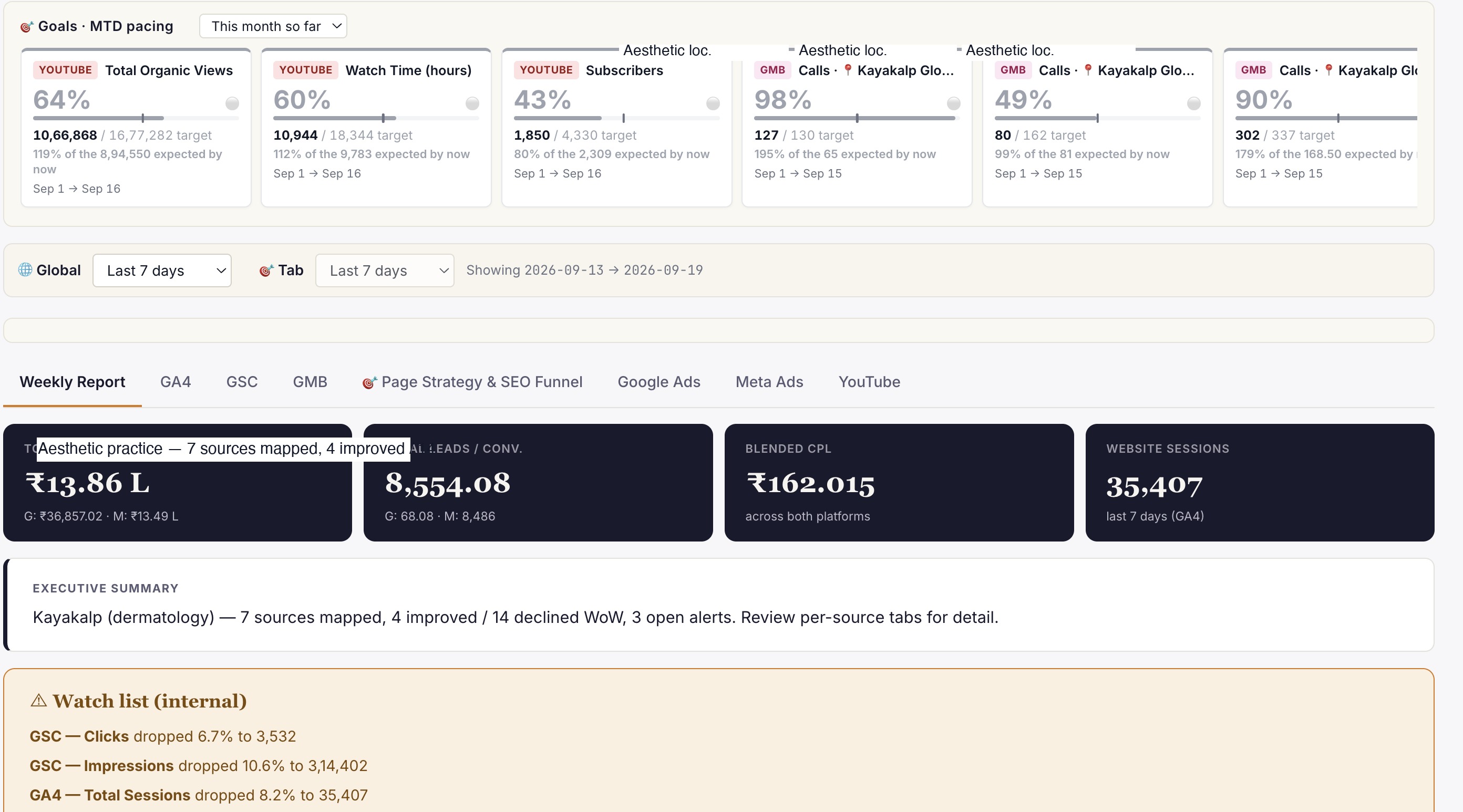
Live client dashboard. GSC, GA4, Google Ads, Meta Ads, IVR calls in one view. Login anytime, not monthly.
Phoenix
Clinic revenue intelligence over your PMS. Daily action queue: Prevent Loss, Maintain & Engage, Grow Revenue. Multi-centre rollout.
Or book a free 30-min audit to see all three in action on your account.
Healthcare brands
that already run on ICG.
A representative slice of the 150+ healthcare brands ICG has delivered for across India. Most engagements remain under NDA.


What ICG clients say · on video.
"Scale up of organic channels and business consulting. ICG has absolute domain authority in their field."
"Working with ICG transformed how we acquire IVF patients in Gurgaon. They understand the fertility journey from inquiry to consult..."
"What Ichelon accomplished — they got all my ideas and worked over 3-4 months to create an amazing, super-customised website."
Need help operationalising this?
Every ICG service is healthcare-only, NMC + DPDP-aware, and built around the patient-research patterns that drive Indian healthcare growth in 2026.
Every practice welcome — packages from ₹20,000/mo.
Goals-Driven engagements · Performance-Linked Payout Models available


More from
ICG.
Five trends shaping Indian healthcare marketing through 2027: AI-first patient research, Conversions API adoption, ABDM discovery, the AEO w...
Healthcare AIO is the discipline of getting your clinic or hospital cited inside Google AI Overviews, ChatGPT and Perplexity answers — not j...
Conversational-search advertising places brand messages inside AI chat answers — ChatGPT, Perplexity, Copilot — rather than beside a results...
Stop guessing.
Book a Diagnostic.
30 minutes. Free. With the AI-powered healthcare-only marketing agency 150+ brands already run on. No slides, no pitch, no hard close.


