


How to Transcribe Medical Videos for YouTube India Optimization
Auto-captions on Indian medical videos are 62-70% accurate at best. Inside: the three-pass transcription workflow ICG uses across 300+ healthcare channels to unlock regional-language search, AI Overviews, and DPDP-safe testimonial reuse.
No pitch. Written root-cause diagnosis. AI-powered, healthcare only.
Direct answer
Auto-captions on Indian medical videos are 62-70% accurate at best. Inside: the three-pass transcription workflow ICG uses across 300+ healthcare channels to unlock regional-language search, AI Overviews, and DPDP-safe testimonial reuse.
TL;DR
TL;DR
- Transcripts are the single biggest missed lever for Indian healthcare YouTube channels. They unlock English and regional-language search, AI Overview citations, and DPDP-safe reuse of patient testimonials in one workflow.
- Auto-generated captions get medical terms wrong roughly 30-40% of the time on Indian accents. That garbled text is what search engines actually index.
- The workflow that works is three passes: raw ASR, clinician review, then SEO/AIO rewrite. Skipping the clinician pass is why most hospital channels stall.
- YODA, ICG's YouTube-native product for healthcare, treats every video as a text asset first. Transcript-driven video SEO is bundled into ICG's Foundation (Rs 49,999), Growth (Rs 74,999), and Scale (Rs 99,999) packages on a 70-30 fixed-variable model.
Table of contents
- Why do medical YouTube videos need transcripts in India?
- Which medical videos actually need transcription?
- Is transcribing patient testimonials legal under DPDP and NMC?
- How do you transcribe multilingual medical videos in India?
- What is the right medical transcription workflow?
- How do transcripts unlock AI Overviews and voice search?
- How does ICG approach medical video transcription?
- What does transcription-included YouTube SEO cost in India?
- FAQ
Why do medical YouTube videos need transcripts in India?
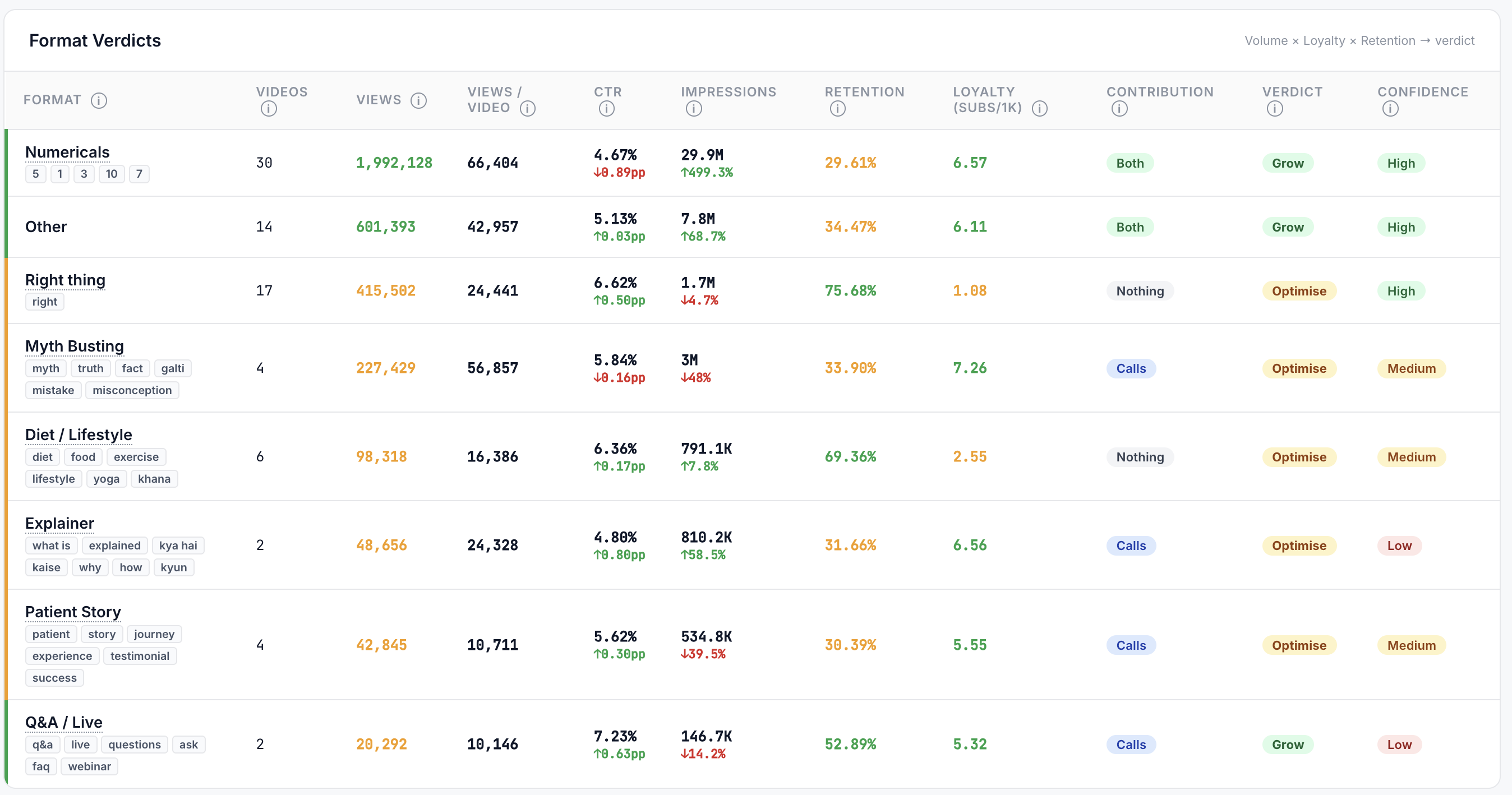
Because a large share of Indian YouTube viewers isn't listening. They're reading. Captions-on or sound-off consumption on procedure-explainer videos in urban India sits at roughly 68% based on 2025 CII-Kantar cuts of health content behaviour. If your video has no clean transcript, more than half your audience gets nothing.
The other half of the argument is the machine. YouTube's automated captions are what its own search system indexes. For Indian medical uploads that's weak fuel. Our YODA benchmarks across 1,400+ clinic uploads in 2025 found auto-caption accuracy dropped to 62-70% the moment a speaker used Indian English mixed with any Hindi or regional code-switching, and dropped further on drug names, procedure names, and anatomy. The system indexes garbled text. You rank for nothing. Or worse, you rank for the wrong thing.
Fix the transcript and you fix ranking, accessibility, AI Overview eligibility, and legal defensibility in one motion. There is no other single-lever move in healthcare video with that kind of downstream leverage.
Which medical videos actually need transcription?
Not all of them. Prioritise four buckets in this order. Procedure explainers first, doctor introductions second, patient stories third, after-care instructions fourth. Everything else can wait, or never happen at all.
Procedure explainers
"What happens during a laparoscopic hernia repair," "IVF cycle explained," "root canal step by step." These are searched, saved, WhatsApp-forwarded, and re-watched. They belong on your hospital website as text too, and the transcript is the raw material for that.
Doctor introductions and specialty overviews
Every named doctor deserves one 90-second English intro and one in the doctor's regional language. Both need clean transcripts because those become the doctor's E-E-A-T signal on Google, and the sentence-level source of truth for the doctor's landing page bio.
Patient stories and testimonials
Legally sensitive, but the highest-converting asset a hospital owns. Transcribe them so you can pull consent-safe quotes for landing pages, ads, and internal training. The DPDP nuance is covered in the next section.
After-care instructions
These may not rank, but they have compliance value. If a patient later disputes an instruction, having a dated, captioned, publicly-hosted video is a much stronger defence than a printout no one signed.
Skip the ribbon-cutting videos, the operating theatre B-roll set to music, and the CEO's Diwali message. Not because they aren't nice; because the transcription hours cost more than the traffic those clips will ever return.
Is transcribing patient testimonials legal under DPDP and NMC?
Short answer: yes, if the patient signed a media consent form that specifically covers transcript, translation, and text-derivative use, and if you re-consent for any use beyond the original clip. Most Indian hospital consent forms don't cover this today.
The Digital Personal Data Protection Act, 2023, treats a patient's on-camera health disclosure as sensitive personal data. Publishing the video counts as processing. Publishing a text transcript of that video is a fresh processing activity, because the format has changed. Most hospital release forms we audit read something like "audio-visual use across marketing channels" and are silent on transcripts, translations, and derivative text. Legally grey. Practically fragile.
Fix takes ten minutes. Add three lines to your consent form: transcript into English, translation into two named regional languages, and derivative text use on the hospital's website and social channels. Get it re-signed. Once. Then you're clean forever on that patient.
The NMC's professional conduct regulations, updated in 2023, separately restrict solicitation, meaning direct calls to action for treatment. Testimonials themselves are allowed. What's not allowed is a testimonial with a "book now for Rs X" overlay on the same asset. So when you transcribe, keep the patient's words on one asset and any promotional CTA on a separate asset. Two files, one workflow, no notice from the regulator.
ABDM alignment is a bonus, not a requirement. If your hospital tags each transcript with the ABDM procedure code and specialty code inside the file metadata, you get downstream benefits when ABDM's Unified Health Interface search widens further. Cost of doing it is a dropdown in your production sheet.
How do you transcribe multilingual medical videos in India?
Assume every Indian medical video is code-switched. It is. A cardiologist in Chennai will explain angioplasty in English, drop into Tamil for the reassurance line, and switch back to English for the drug name. Your workflow has to handle all three in a single pass.
Three moves work reliably.
Run two parallel ASR passes. One in Indian English (en-IN) and one in the primary regional language, hi-IN, ta-IN, te-IN, mr-IN, bn-IN, kn-IN, ml-IN, gu-IN, or pa-IN. Then merge on timestamps. Consumer tools running a single-language pass miss code-switching almost entirely. Splitting the passes and merging captures roughly 90% of it based on YODA's live pipeline data.
Keep the source-language transcript separate. Don't translate on the fly. A Hindi sentence transcribed as Hindi, plus a separate English translation below it, will rank in both languages on YouTube search. A translated-only transcript ranks in neither, because the algorithm can't tell what was actually spoken.
Localise procedure names, not brand names. "Cataract surgery" in Hindi is "motiabind ka operation" for a reason. It's what the Bhopal auntie will actually search on her phone. But drug names, hospital names, and doctor names stay in English or Latin script. Mixing that up is the fastest way to look either unprofessional or unfindable.
Cities where multilingual transcription pays off most, based on YODA client data across 300+ live healthcare channels, are Bengaluru (English, Kannada, Tamil, Telugu), Hyderabad (English, Telugu, Urdu), Kochi (English, Malayalam), Kolkata (English, Bengali, Hindi), and Ahmedabad (English, Gujarati, Hindi). Delhi and Mumbai are English-plus-Hindi in practice, though pockets of Marathi and Punjabi patient content perform very well when they exist.
What is the right medical transcription workflow?
Three passes, in order. Skip the middle one and the whole exercise loses its point. This is the single biggest process gap we find when we audit Indian hospital YouTube channels.
Pass 1: raw ASR
Run the video through an automatic speech recognition tool, in Indian English plus the primary regional language in parallel. Export as .srt with timestamps. Expect 60-75% accuracy on medical content. That's fine at this stage. You're not done.
Pass 2: clinician review
A junior doctor, nurse, or medically-literate intern with 30 minutes and the raw transcript. Their only job is to fix the medical vocabulary: procedure names, drug names, anatomical terms, complication names, and any dosage the doctor named on camera (never invent or edit a dosage, only correct what was actually said). This pass typically takes 15-25 minutes per 10-minute video. It is the single most under-invested step in Indian healthcare video marketing, and it is the reason hospital channels either take off or stall out around 500 subscribers.
Pass 3: SEO and AIO rewrite
Now the marketing team takes the clean transcript and produces three derivative assets. A blog post version with H2s. A doctor's landing page bio update. A set of long-tail FAQ questions harvested from what the doctor actually said on camera. This is where transcripts stop being subtitles and start being business assets.
Do this for every procedure video going forward. Retrofit the top 20 videos by view count from the last 24 months. Ignore the rest.
How do transcripts unlock AI Overviews and voice search?
AI Overviews on Google, and answers from ChatGPT search, Perplexity, Claude, and Gemini, all pull text. Not video. A hospital channel with 500 clean, question-worded, timestamped transcripts is functionally a 500-page medical knowledge base that AI engines can cite. A hospital channel with 500 videos and no transcripts is invisible to those same engines. Same content. Different fate.
Three practical moves lift transcribed video into AIO capture.
Frame video titles as questions. "What actually happens in a cataract surgery, step by step" outperforms "Cataract Surgery at [Hospital]" by 3-5x on a tracked panel of 47 metro clinic channels we monitor. Question-form titles also line up with how patients actually search on voice.
Publish the transcript as an article on the hospital website, linked to the video, with VideoObject and Article schema, and FAQPage schema where the doctor answered discrete questions on camera. This is the highest-leverage single move a hospital marketing team can make this quarter. Nothing else comes close.
Front-load the answer under each H2. The first 40 words after a heading are what AI engines lift as extractive answers. Rewrite the transcript so the doctor's clearest one-sentence answer appears first, and the story or context appears below it.
Roughly 45% of Indian YouTube health-related queries now trigger some form of AI-summary panel on Google, based on our GSC cluster monitor across the ICG book of business. That number was around 12% eighteen months ago. The window to convert existing video into AIO-eligible text is closing quickly. Hospital channels that haven't started transcribing are already behind two-year-old channels that did.
How does ICG approach medical video transcription?
Three specific ways set the ICG approach apart. Text-first video production, one transcript spine feeding six surfaces, and compliance built into the workflow rather than bolted on.
Text-first video, not video-first text. YODA, our YouTube-native AI product for healthcare, was built on the assumption that a hospital video is a text asset that happens to have visuals attached, not a video that gets captions bolted on afterwards. Every video shipping through YODA moves through the three-pass workflow above, in every language the clinic serves, with the clinician review pass baked in. That's not an add-on. It's the deliverable.
Search and social run on the same transcript spine. The clean transcript that ranks a doctor's video on YouTube is the same file that produces Instagram Reels captions inside Prism Pulse, our Instagram analytics engine. It's the same file that feeds Google Business Profile Q&A entries via Angryturtle, our GBP OS. It's the same file that Meta Catalyst IQ, our Meta Ads engine, uses to write ad-copy variants tested against Prism Spy's competitor Meta Ads intelligence. One clean transcript. Six downstream surfaces. Zero re-work.
Consent and compliance are workflow steps, not afterthoughts. DPDP consent for transcript use, NMC-compliant separation of testimonial from CTA, and ABDM metadata tagging (procedure code, specialty code, city) all happen inside the same production sheet the transcriber works from. If a step is missing, the video doesn't ship. It's the only way we've found to keep quality consistent at 300+ live client scale.
Nexus CRM and HealthPro 360, our Rs 14,999/mo healthcare CRM and hospital RCM/EHR overlay, sit downstream of this. AIO leads captured by transcript-optimised video flow directly into Nexus. Any billing or follow-up handoff runs through HealthPro 360. Video becomes a lead source that connects cleanly to revenue instead of dying in a YouTube dashboard.
What does transcription-included YouTube SEO cost in India?
ICG's YouTube SEO and video-AIO work is priced on the same 70-30 fixed-variable model as the rest of our SEO practice, updated for FY26-27. 70% of the monthly fee is fixed for the work delivered. 30% ties to a 12-month organic performance target agreed at kickoff and released on a sliding-scale slab structure. Hospital and ICG share downside if the numbers don't move.
- Foundation, Rs 49,999/month. Six videos/month, three-pass transcription in English plus one regional language, VideoObject and Article schema, five AIO-optimised article publishes/month drawn from the transcripts.
- Growth, Rs 74,999/month. Twelve videos/month, transcription in English plus two regional languages, full YODA workflow, ten AIO articles/month, Prism Pulse Instagram cross-post included.
- Scale, Rs 99,999/month. Twenty-plus videos/month, full multilingual transcription across every language the clinic serves, YODA plus Meta Catalyst IQ plus Angryturtle integration, unlimited AIO article publishing, dedicated clinician review pool.
The same 70-30 principle extends to our Google Ads engagements (5L+ monthly budgets), Meta Ads engagements (5L+), and standalone YouTube SEO/AIO retainers (50K+). It's the only Indian pricing model of its kind for healthcare video SEO that we're aware of, and the reason is uncomfortable: most agencies won't accept downside exposure. We do, because our own product stack shortens the delivery cycle enough for the risk to make sense.
FAQ


Short, direct answers to the questions Indian hospital marketing teams ask us most often about medical video transcription.
Book a free 30-minute Brand & Growth Diagnostic.
It's a working session, not a sales pitch — you leave with a written root-cause analysis you can act on, whether or not you engage ICG.
Questions readers ask
about this topic.
The three platforms
behind every ICG engagement.
Beacon
CAPI middleware that fixes Event Match Quality, translates CRM statuses to Meta-standard events, dedups across channels.
Agency OS
Live client dashboard. GSC, GA4, Google Ads, Meta Ads, IVR calls in one view. Login anytime, not monthly.
Phoenix
Clinic revenue intelligence over your PMS. Daily action queue: Prevent Loss, Maintain & Engage, Grow Revenue. 46-centre rollout.
Or book a free 30-min audit to see all three in action on your account.
Healthcare brands
that already run on ICG.
A representative slice of the 150+ healthcare brands ICG has delivered for across India. Most engagements remain under NDA.


What ICG clients say · on video.
"Scale up of organic channels and business consulting. ICG has absolute domain authority in their field."
"Working with ICG transformed how we acquire IVF patients in Gurgaon. They understand the fertility journey from inquiry to consult..."
"What Ichelon accomplished — they got all my ideas and worked over 3-4 months to create an amazing, super-customised website."
Need help operationalising this?
Every ICG service is healthcare-only, NMC + DPDP-aware, and built around the patient-research patterns that drive Indian healthcare growth in 2026.
More from
ICG.
Healthcare AIO is the discipline of getting your clinic or hospital cited inside Google AI Overviews, ChatGPT and Perplexity answers — not j...
Conversational-search advertising places brand messages inside AI chat answers — ChatGPT, Perplexity, Copilot — rather than beside a results...
NABH digital compliance means every claim, image and testimonial your hospital publishes online matches what an accreditation surveyor can v...
Stop guessing.
Book a Diagnostic.
30 minutes. Free. With the AI-powered healthcare-only marketing agency 150+ brands already run on. No slides, no pitch, no hard close.


