


How to choose a clinic website developer: ownership, access, and the handover that decides everything
TL;DR: How to choose a clinic website developer comes down to one question buyers skip: who owns the domain, hosting, CMS and analytics once the invoice is paid. Design is the least consequential part of this decision. Technical capability to rank, lawful handling of patient da
No pitch. Written root-cause diagnosis. AI-powered, healthcare only.
Direct answer
TL;DR: How to choose a clinic website developer comes down to one question buyers skip: who owns the domain, hosting, CMS and analytics once the invoice is paid. Design is the least consequential part of this decision. Technical capability to rank, lawful handling of patient da
TL;DR

Author: Deep Das, AI and Product Lead · Reviewer: Hanuman Sihag, Head of Innovation Chamber & SEO Lead · Last updated 2026-07-30 · Editorial standards
TL;DR: How to choose a clinic website developer comes down to one question buyers skip: who owns the domain, hosting, CMS and analytics once the invoice is paid. Design is the least consequential part of this decision. Technical capability to rank, lawful handling of patient data, and whether the clinic can update the site after the developer leaves matter more. This framework also says plainly when ICG is not the right choice.
Table of contents
- Who should own what
- The scoring framework: what technical competence looks like
- Red flags: the handover that never comes
- Cost expectations: build versus maintain
- Timeline and the content-readiness constraint
- The honest archetype recommendations
- FAQ
Who should own what
Six things decide whether a clinic can ever leave its developer: domain registration, the hosting account, DNS, the CMS admin login, the code repository, and the analytics property. All six need to sit in the clinic's own name, not the developer's. Anyone working through how to choose a clinic website developer should treat this as the first filter, before design samples or price quotes even come up.
It is extremely common in the Indian small-clinic market for a developer to register the domain under their own name, host the site on their own reseller account, or keep the only admin login after go-live. Sometimes this is convenience. Sometimes it is a way to keep the client tied to them. Either way the clinic finds out only when it wants to leave — and by then it often can't move the site, can't update a phone number or a doctor's name, and in a few cases can't even get back into its own analytics account. The same ownership questions apply whether the site belongs to a single clinic or a multi-location group — hospital website development in India scales very differently across those two; the risk doesn't shrink with scale, it just gets more expensive to fix.
Design is what buyers evaluate first and it is the least consequential part of the decision. A clinic can redesign a site in a weekend once it owns everything underneath it. It cannot recover a domain registered in someone else's email address without a fight.
The scoring framework: what technical competence looks like
A technically capable build does specific things whether or not the front end looks impressive: clean, crawlable URLs; content that a search engine can actually read without executing a pile of JavaScript first; a heading structure that makes sense; schema markup that describes what the practice actually is. A visually striking site shipped as a single JavaScript bundle with no server-rendered content will struggle to rank no matter how the homepage looks in a screenshot — which is exactly why clinic website developer selection has to include a technical scoring exercise, not just a portfolio review.
Score the developer you're evaluating 0, 1 or 2 on each of the seven criteria below, out of a stated maximum of 14.
Ownership and access practices
Does the proposal or contract state, in writing, that the clinic owns the domain, hosting, CMS, code repository and analytics property? Score 2 for a written clause, 1 for a verbal assurance, 0 for silence. Is there a named handover plan — a specific list of credentials the clinic receives before final payment — rather than a vague promise to "hand everything over"? Score 2 for a written plan, 0 if the question gets a shrug.
Technical and ranking capability
Are URLs clean and does every page get a unique title and meta description, or does the whole site share one generic tag? Does the templating framework serve crawlable, largely server-rendered content, or is it a client-side app with a blank initial page source? Does the developer implement schema markup — MedicalOrganization, Physician, MedicalClinic — as a matter of course, and can they explain what it does rather than repeating "it helps SEO" without specifics? A developer who can answer these three cleanly has cleared the bar that most medical website design agency india shortlists never actually test for. ICG's own approach to these criteria is described on its SEO service page.
Data handling and compliance
Healthcare website compliance in India starts here, not with a cookie banner: appointment and enquiry forms collect patient personal data, which puts them squarely inside DPDP Act 2023. Does the developer capture and record consent at the point of submission, or does the form just fire an email? Is that email the only place the data goes — plain text, landing in a shared inbox anyone on staff can read — or is there an actual system behind it? Plain-text form-to-email is close to universal in this market and is a genuine exposure, not a theoretical one. Separately: does the developer understand that NMC's 2026 advertising guidelines constrains what a clinic's own website can say, not just what it advertises elsewhere — outcome claims, patient testimonials, and comparative claims about being the best in the area are all in scope, and a developer who ships a testimonial carousel as a default feature without flagging this has handed the clinic something it may not be allowed to use. Related NMC territory, specifically for doctors' personal social accounts rather than the clinic site, is covered in ICG's guide to NMC Section 6 social media compliance.
| Score | Interpretation |
|---|---|
| 11–14 | Strong candidate — ownership, technical practice and compliance awareness are already built into how they work |
| 6–10 | Workable, but get the missing items written into the contract before signing |
| 0–5 | Reconsider — the gaps are structural, not something a revised quote fixes |
Red flags: the handover that never comes
A developer can be genuinely good on price and design and still be the wrong choice, because none of that matters if the handover never happens. The general rule — never work with anyone who won't commit to transferring access — has one narrow exception worth naming: a developer who is transparent about a temporary hosting arrangement during build, with a written date for transfer, isn't a red flag. A developer who goes quiet on the question is.
A few signs that the handover isn't coming:
- The developer still holds the only admin login weeks after go-live, with no fixed date to change that
- The domain is registered under the developer's name or personal email address, not the clinic's
- Nothing in the contract mentions handover at all
- Questions about who owns the Google Analytics or Search Console property get a vague or evasive answer
- A testimonial carousel or outcome-claim section ships by default with no one on the team raising a compliance flag
Before final payment, a clinic should hold, in its own name:
- Domain registrar login
- Hosting account login
- DNS management access
- CMS admin account
- Code repository access, or a full source code export if there's no repository
- Google Analytics and Search Console property ownership
That list is the single most useful thing on this page. Almost no clinic asks for it, and almost no developer volunteers it.
Cost expectations: build versus maintain
Two quotes for the same clinic website can differ by a factor of five and both be honest. One is noticeably cheaper. The difference, more often than price-shopping instinct suggests, is that the cheaper one covers only the build — and a website is not a one-off purchase. Hosting, SSL renewal, security and CMS updates, backups, and ordinary content changes (a new doctor joins, a service gets renamed, clinic hours change for a holiday) keep happening long after launch, and someone has to be paying for them to happen.
Clinic website cost india questions usually arrive framed as template versus custom, and the honest answer doesn't flatter either option automatically. A well-implemented template beats a badly executed custom build, full stop — most single-doctor and small multi-doctor practices don't have a requirement a good template can't meet. Custom development earns its premium only where there's a real functional need a template genuinely can't satisfy: a booking system tied to a specific EMR, multi-location logic, a patient portal. Ask what specific requirement justifies the custom quote before accepting that it does.
Timeline and the content-readiness constraint
Most clinic website delays are not development delays. That's the predictable part, and it's worth stating before anything else in this section, because it changes what a clinic should actually prepare for before signing. The bottleneck is almost always content: doctor bios that need writing, service descriptions that need approving, photographs that haven't been taken yet, sign-off from a partner who's traveling.
A developer with an actual content workflow — a shared document with named owners and dates, reminders sent when something is overdue — gets these projects live. One who waits passively for the clinic to send everything whenever it gets around to it does not, and the clinic ends up carrying the blame for a delay the process itself invited.
One related question worth asking during the same conversation: does the finished site pass enquiries into whatever system the clinic actually uses to track leads, or does every form submission dead-end in an inbox nobody checks consistently? ICG's hospital CRM decision framework covers that choice in full — this page is flagging the question, not the framework itself, and that companion piece is not yet published as of this writing.
The honest archetype recommendations
Four kinds of developer show up in this market, and each is right for some clinics and wrong for others. None of them is right for everyone, including ICG, named plainly below.
A healthcare web specialist builds ownership terms and compliance awareness into the default contract rather than treating them as an add-on a client has to request. Ask one what happens to the domain at handover and the answer is already rehearsed, not improvised. When this fails: a specialist with no real SEO or performance-marketing capability behind the build leaves a clinic needing three separate vendors instead of one, and paying a specialist premium without getting the depth that premium implies.
A clinic that hires a well-regarded general web agency usually gets a genuinely good-looking site — strong photography, clean layout, fast load times — with zero clinical compliance awareness baked in anywhere. Nobody on the build team had read NMC's 2026 advertising guidelines, so the proposal included a testimonial carousel and a "why we're the best clinic in the area" section as standard features, both of which the clinic now has to strip out or risk a complaint. When this fails: almost by default, because the compliance gap isn't a one-off oversight, it's the structural result of a team that has never had a reason to know this vocabulary.
A well-configured template platform is enough for most single-doctor practices, and saying so plainly matters more than it sounds like it should, because the market has an incentive to talk every clinic into custom work whether or not it needs it. When this fails: clinics with multiple locations, multiple specialties, or an integration requirement a template genuinely can't support — at that point the platform's limitations stop being theoretical and start costing real appointments.
Before the case for a freelance developer, the caveat: freelancers are the most commonly chosen option for small clinics in India, and also the origin of most ownership failures this page exists to warn about, because there is no company behind the individual, no continuity if they stop responding, and often no written handover clause at all. That said, a freelancer who puts ownership terms in writing and has a track record a clinic can actually verify is frequently the most cost-effective option available, and dismissing the category outright would be its own kind of dishonesty. When this fails: the freelancer disappears, changes numbers, or simply stops replying, and the clinic discovers it never held its own domain registration in the first place.
ICG operates in this market as a healthcare web specialist, and this page is published by ICG and names ICG as one of the four options being weighed — that conflict is worth saying outright rather than leaving implicit. Before making the case for it: ICG's managed service costs more than a freelancer and is scoped specifically for healthcare practices, which is a limitation for anyone outside that scope, not a footnote. Within that scope, the case is that ownership, technical build quality and DPDP/NMC awareness come as the default rather than something a clinic has to negotiate for line by line — proof points from ICG's own client work are at ICG's CPQL benchmarks page, based on 46 active healthcare client engagements across a rolling 12-month window (July 2025 to July 2026) across Delhi NCR, Mumbai, Bangalore, Chennai, Hyderabad and Kolkata, last verified 2026-07-26. When this fails: a single-doctor practice whose realistic need is a one-page presence backed by a well-managed Google Business Profile doesn't need a managed healthcare-web-specialist service, and paying for one is paying for scope the practice will never use.
When ICG is not the right answer more broadly: single-doctor practices where a template plus a well-run Google Business Profile is genuinely sufficient and cheaper; clinics that already have an in-house developer handling this work; anyone wanting a purely visual redesign with no technical or compliance change involved; and practices that aren't willing to maintain the site after launch, since a managed service assumes ongoing engagement rather than a one-time delivery.
FAQ
Who should own the domain for a clinic website? The clinic, always, registered under the clinic's own name and its own email address rather than the developer's. This is the single fact that decides whether the clinic can ever change developers without a fight.
What do I need to have in my own name before I make final payment? Domain registrar login, hosting account login, DNS management access, CMS admin account, code repository access or a full source export, and ownership of the Google Analytics and Search Console properties. Get all six before the last invoice is paid, not after.
Is a template good enough, or do I need a custom build? For most single-doctor and small multi-doctor practices, a well-implemented template is genuinely enough. Custom development is worth paying for only when there's a specific requirement — multi-location logic, an EMR integration, a patient portal — that a template can't meet.
What does maintenance actually cover after launch? Hosting, SSL renewal, security and CMS updates, backups, and routine content changes like a new doctor's bio or updated clinic hours. A quote covering only the build doesn't include any of this, and it keeps being needed for as long as the site is live.
How do I know if a developer's SEO claims are real? Ask specifically about crawlable page structure, unique titles and meta descriptions per page, and schema markup — and listen for whether they can explain what schema actually does rather than repeating that it "helps SEO." A vague answer to a specific question is itself the answer.
What should a clinic website do with patient data collected through forms? Capture and record consent at submission, and route the data somewhere more secure than a shared inbox receiving plain-text emails. DPDP Act 2023 applies to appointment and enquiry forms because they collect patient personal data.
Can a developer legally put patient testimonials on our site? NMC's 2026 advertising guidelines constrains outcome claims, testimonials and comparative claims on a clinic's own website, not just in advertising. A developer who builds a testimonial carousel as a default feature without raising this is handing the clinic something it may not be able to use as-is.
What happens if our developer disappears after launch? If the clinic already holds its own domain, hosting and CMS access, not much — a new developer can pick up the site with minimal disruption. If the previous developer held any of that in their own name, the clinic can be locked out of its own website with no easy way back in.
Book a free website architecture review.
Hanuman Sihag reviews your current site (or wireframe) for SEO foundations, Core Web Vitals, schema, and mobile-first patient journey. 45 minutes.
The three platforms
behind every ICG engagement.
Beacon
CAPI middleware that fixes Event Match Quality, translates CRM statuses to Meta-standard events, dedups across channels.
Agency OS
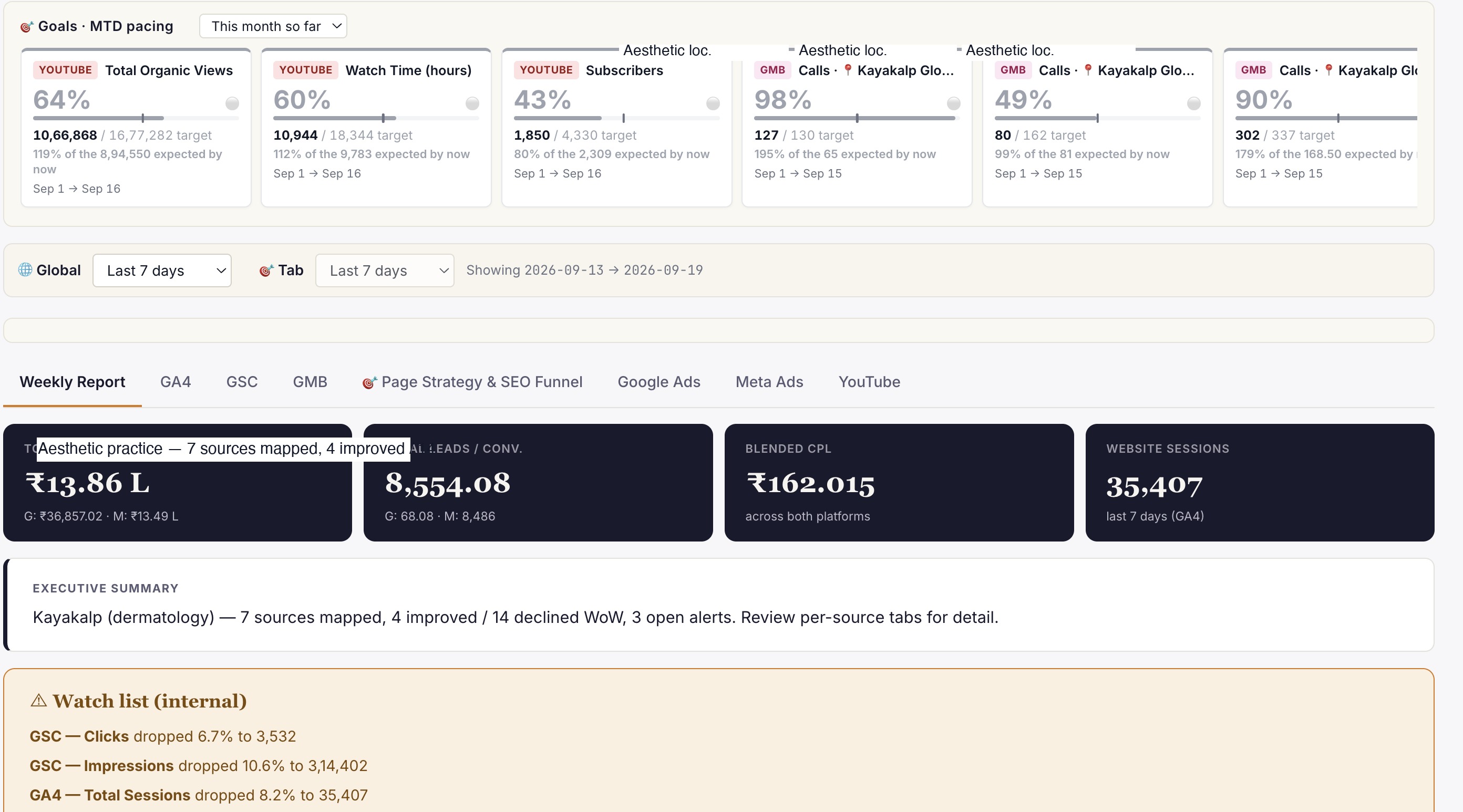
Live client dashboard. GSC, GA4, Google Ads, Meta Ads, IVR calls in one view. Login anytime, not monthly.
Phoenix
Clinic revenue intelligence over your PMS. Daily action queue: Prevent Loss, Maintain & Engage, Grow Revenue. Multi-centre rollout.
Or book a free 30-min audit to see all three in action on your account.
Healthcare brands
that already run on ICG.
A representative slice of the 150+ healthcare brands ICG has delivered for across India. Most engagements remain under NDA.


What ICG clients say · on video.
"Scale up of organic channels and business consulting. ICG has absolute domain authority in their field."
"Working with ICG transformed how we acquire IVF patients in Gurgaon. They understand the fertility journey from inquiry to consult..."
"What Ichelon accomplished — they got all my ideas and worked over 3-4 months to create an amazing, super-customised website."
Need help operationalising this?
Every ICG service is healthcare-only, NMC + DPDP-aware, and built around the patient-research patterns that drive Indian healthcare growth in 2026.
Every practice welcome — packages from ₹20,000/mo.
Goals-Driven engagements · Performance-Linked Payout Models available


More from
ICG.
Five trends shaping Indian healthcare marketing through 2027: AI-first patient research, Conversions API adoption, ABDM discovery, the AEO w...
Healthcare AIO is the discipline of getting your clinic or hospital cited inside Google AI Overviews, ChatGPT and Perplexity answers — not j...
Conversational-search advertising places brand messages inside AI chat answers — ChatGPT, Perplexity, Copilot — rather than beside a results...
Stop guessing.
Book a Diagnostic.
30 minutes. Free. With the AI-powered healthcare-only marketing agency 150+ brands already run on. No slides, no pitch, no hard close.


