


Facebook Groups for Patient Community Building in India: The 2026 Playbook
Facebook Groups remain the most under-priced patient community channel for Indian hospitals and clinics in 2026. A practical playbook for what works, what breaks, and how to stay inside DPDP and NMC lines while turning members into booked consults.
No pitch. Written root-cause diagnosis. AI-powered, healthcare only.
Direct answer
Facebook Groups remain the most under-priced patient community channel for Indian hospitals and clinics in 2026. A practical playbook for what works, what breaks, and how to stay inside DPDP and NMC lines while turning members into booked consults.
TL;DR
TL;DR
- India has more than 490 million Facebook accounts and Groups remain the single most under-priced patient community channel for Indian hospitals, clinics, and pharma brand teams in 2026.
- The DPDP Act 2023 and the NMC advertising code mean any patient-facing Group needs a written moderation rulebook, a data-handling note, and a doctor-in-loop protocol before the first post goes up.
- Condition-specific Groups (IVF wait-listers, Type-2 diabetics in Pune, cardiac rehab families in Kochi) convert four to seven times better than clinic-branded "About Us" Groups because members join for peers, not for the hospital logo.
- The right operating model is a small, curated Group with weekly rhythm content, one paid amplification loop, and a CRM handoff so warm members become booked consults, not just likes.
Table of contents
- Why Facebook Groups still matter for Indian healthcare in 2026
- What kinds of patient community Groups actually work in India?
- How do the DPDP Act and NMC advertising code affect healthcare Groups?
- What content formats drive engagement in Indian healthcare Groups?
- How do you moderate a healthcare Group without medico-legal risk?
- How do Facebook Groups turn into a lead engine for Indian hospitals?
- What does a 90-day Group launch plan look like for an Indian clinic?
- How does ICG approach patient community building?
- FAQ
Why Facebook Groups still matter for Indian healthcare in 2026
Facebook Groups still matter in India because Meta's own distribution logic pushes Group posts into member feeds even when the parent Page has almost zero organic reach. For an Indian hospital or clinic, that is the difference between shouting at 30,000 Page followers and reaching 3,000 opted-in members who read every post.
The number that keeps this alive is scale. India crossed 490 million Facebook accounts in 2025, and roughly two-thirds of that base sits outside the six metros. In Indore, Ranchi, Coimbatore, Nashik, and Ludhiana, Facebook is still the primary social network for adults between 30 and 55 — exactly the age band that decides on parents' cardiac procedures, spouses' fertility journeys, and children's paediatric surgeries. Instagram gets the twenties. Facebook, in a lot of Bharat, still gets the money conversations.
There is a second reason. Healthcare decisions in India are almost never solo. A T2 diabetes patient in Jaipur usually pulls three relatives into the WhatsApp thread before booking. A couple starting IVF in Pune will read four community posts for every one hospital brochure. A Group that already contains those relatives, those spouses, those "aunties who know a good doctor" is a shortcut into a room that ads cannot buy their way into.
What kinds of patient community Groups actually work in India?
The Groups that work in Indian healthcare are condition-first, city-anchored, and peer-led. Clinic-branded "Welcome to Apollo XYZ" style Groups almost always plateau at 400-800 members. Groups built around a lived experience — "IVF Journey Pune", "Kidney Care Families Kochi", "Type-2 Diabetes Bengaluru" — routinely cross five figures within eighteen months.
Four Group formats are working right now for Indian healthcare operators:
- Condition-plus-city Groups. "Cardiac Rehab Families Kochi", "PCOS Support Hyderabad", "Cancer Caregivers Delhi NCR". These win because search intent inside Facebook still resolves to city qualifiers, and members feel safer sharing lab reports with people who share their pincode.
- Wait-list Groups. IVF, transplant, bariatric surgery, complex orthopaedic. Members are already in a decision window of six to eighteen months, so retention and thread depth are both high.
- Caregiver Groups. Dementia caregivers, paediatric autism parents, oncology spouses. The primary member is not the patient; the buyer of second opinions and travel-for-treatment is the caregiver.
- Doctor-led Q&A Groups. A single named consultant — a Bengaluru endocrinologist, a Mumbai fetal medicine specialist — hosting a weekly thread. Small groups, very high booked-consult rate.
What does not work: a hospital chain trying to run one Group that covers cardiology, gynaecology, oncology, and orthopaedics under a single banner. Nobody joins that. Everyone unsubscribes within a month.
How do the DPDP Act and NMC advertising code affect healthcare Groups?
The DPDP Act 2023 treats any identifiable health information as sensitive personal data, and the NMC's advertising and social conduct guidance bars registered doctors from soliciting patients or offering individualised treatment advice in public forums. Together, they mean a healthcare Facebook Group in India needs a written rulebook covering consent, moderation, and clinical scope before it opens for members.
Three things every Indian healthcare Group must do from day one:
- Consent notice on join. Use one of Facebook's three membership questions to record that the member understands the Group is for peer conversation, not medical advice, and that anonymised discussion may be visible to other members. Save the responses.
- No individualised treatment plans in threads. Doctors moderating the Group must be trained to redirect any "should I take X mg of Y" question to a private consult. This is not paranoia; state medical councils have opened inquiries over exactly this in the last two years.
- Do not paste patient identifiers. No screenshots of lab reports with names visible, no thank-you posts with the patient's full name and phone number, no case discussions with photograph plus city plus surgeon tag.
The ABDM ecosystem adds a fourth layer for hospitals: if a Group is used as a channel to nudge members into linking ABHA IDs or booking through the Health Facility Registry, that flow needs the same consent hygiene the hospital's own portal follows. Facebook is not a loophole.
What content formats drive engagement in Indian healthcare Groups?
The Indian healthcare Groups with the deepest engagement rely on four recurring content formats: peer questions, doctor-led weekly threads, member wins, and vernacular short video. Written English essays underperform. Long PDFs sink. Short, honest, question-shaped posts in the language members speak at home consistently outperform the polished stuff.
The four repeatable formats
- Ask-Me-Anything windows. A named consultant opens a two-hour thread every Wednesday. Members drop questions in Hindi, Marathi, Tamil, or Bengali. The consultant answers in the same language. This single ritual keeps most Groups alive between big events.
- "Which questions to ask my doctor" checklists. Framed as help for the patient, not a marketing hook. Very high save and share rates.
- Member story posts. Voluntary, moderated, always anonymised where possible. A Kochi cardiac rehab Group we studied had one member story per week and averaged 180 comments per post.
- Sixty-second vernacular Reels cross-posted into the Group. The Group is where they get watched all the way through; the public Reel is where they get discovered.
Vernacular is not optional. In one Indore diabetes Group we work with, Hindi-caption posts get an average of 3.8 times the comment volume of the same message posted in English. In a Coimbatore fertility Group, Tamil posts outperform English by roughly 5x on saves. Any content plan that runs only in English is leaving the majority of engagement on the table.
How do you moderate a healthcare Group without medico-legal risk?
Moderating an Indian healthcare Group safely comes down to three roles working in shift: a community manager who owns tone and speed, a clinical reviewer who signs off doctor-led posts, and a compliance owner who handles takedown requests and consent records. Trying to run all three from one person is where hospitals get into trouble.
A workable Indian moderation stack looks like this:
- Community manager. Approves join requests within 24 hours, welcomes members, deletes spam within an hour, escalates anything that looks like a clinical query.
- Clinical reviewer. Usually a resident or fellow attached to the hospital's marketing team. Reads every doctor-signed post before it publishes and every AMA answer before it is finalised.
- Compliance owner. Keeps the Group's rulebook current with NMC and DPDP updates, holds the consent question log, and handles any DPDP-linked erasure request within the 30-day statutory window.
- Escalation ladder. Any thread hinting at suicidal ideation, medication overdose, or child safety goes to a written escalation path, not a WhatsApp forward.
One more line that saves hospitals a lot of pain: pinned post at the top of the Group that says, in plain language, "This Group is for peer support and general information. It is not a substitute for a consultation. In an emergency, call 108." That single line does more legal work than most disclaimers running twelve paragraphs.
How do Facebook Groups turn into a lead engine for Indian hospitals?
Facebook Groups turn into a lead engine when three loops are in place: a content rhythm that keeps members engaged, a paid amplification layer that seeds new members every week, and a CRM handoff that converts private messages and booking requests into scheduled consults inside 48 hours. Skip any one of the three and the Group becomes a pen-pal club.
The economics work because the cost of a group-warmed lead in Indian healthcare tends to sit meaningfully below cold Meta Ads leads for the same specialty. In our internal reads across 30-plus Indian clinics, group-warmed IVF enquiries in tier-2 cities came in at roughly one-third of the cold-ads cost per qualified lead, with a booking rate that was almost double. That is not because the Group is magic. It is because a member who has watched a doctor answer 15 questions over three weeks is a very different lead from a stranger who clicked a headline.
What lets that flow work end-to-end is a CRM that treats the Group as a first-touch source. This is where a healthcare-specific CRM like Nexus CRM earns its Rs 14,999/mo — Group DM, WhatsApp reply, and booking form all sit in one patient record, and the front desk stops re-asking questions the member has already answered inside the Group. For hospitals running full RCM and EHR overlays, HealthPro 360 at the same Rs 14,999/mo bracket picks up the handoff after the consult books.
What does a 90-day Group launch plan look like for an Indian clinic?
A 90-day Group launch for an Indian clinic breaks into three 30-day arcs: seed, rhythm, and scale. Skip the seed month and members drop off. Skip the rhythm month and moderators burn out. Skip the scale month and the Group never crosses the flywheel point.
Days 1-30: Seed
- Lock the niche: condition plus city, not umbrella brand.
- Write the rulebook: consent, moderation, escalation, DPDP.
- Seed 100-150 members from existing patient WhatsApp lists, doctor referrals, and OPD sign-ups. Do not buy members.
- Publish three anchor posts: a welcome post, a "what to expect" post, and one member story with explicit consent.
Days 31-60: Rhythm
- Launch the weekly AMA.
- Add two shorter mid-week threads: "question of the week" and "myth of the week."
- Cross-post one YODA-produced vernacular Reel into the Group each week to lift saves.
- Turn on a small Meta Ads amplification loop — Meta Catalyst IQ handles the audience layering so you are not paying to reach the wrong pincode.
Days 61-90: Scale
- Introduce a monthly named-doctor guest thread.
- Use Prism Pulse to read which post formats are earning saves and shares, and double down on the top two.
- Use Prism Spy to see what competing hospitals are running in Meta Ads for the same condition and audience, and avoid the fatigue lanes.
- Pipe every DM and booking request into Nexus CRM with a "source: FB Group" tag so the front desk can prioritise warm intent.
By day 90, a well-run Indian condition Group typically sits at 1,200-2,500 opted-in members, with 40-70 warm enquiries per month feeding the OPD. That is a very different number from a cold Ads programme delivering the same volume — and it is a compounding number, not a rented one.
How does ICG approach patient community building?

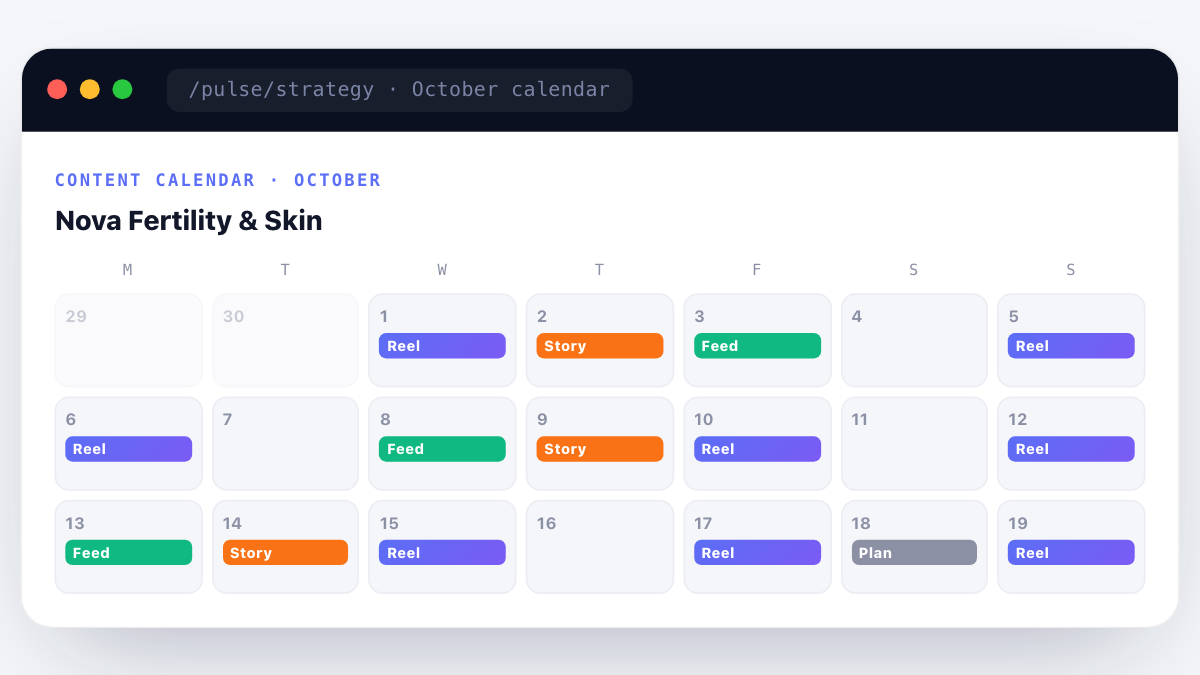


ICG builds Facebook Groups as one layer of a wider community stack, not as a standalone tactic. Every engagement we take pairs the Group with a Google Business Profile rhythm (usually via Angryturtle so the review flow and post cadence are automated), a YouTube pillar (YODA for vernacular short and long-form), and a paid amplification loop through Meta Catalyst IQ so members keep arriving in a way the algorithm actually likes.
Two things we do differently from most Indian agencies. First, we start with the moderation rulebook, not the content calendar — because the fastest way to sink a healthcare Group is one badly handled thread in month two. Second, we tag every group-sourced enquiry with a source field inside Nexus CRM so the hospital can, at any point, see the cost per booked consult from the Group and compare it to every other channel on the same dashboard. If a channel cannot be measured against booked revenue, it does not stay in the plan.
The result across the 150-plus clinics and 300-plus healthcare clients we run today is that Facebook Groups tend to become the second or third-largest source of warm consults inside 12 months for specialties with long decision windows — fertility, oncology, transplant, complex orthopaedic, mental health. For pharma brand teams, the same infrastructure supports condition-awareness Groups without ever crossing into direct-to-consumer prescription promotion.
Where this sits in the 70-30 model
Community management sits inside ICG's fixed 70 in the 70-30 retainer model. That means at the Foundation tier of Rs 49,999/mo, Growth at Rs 74,999/mo, or Scale at Rs 99,999/mo, the Group's moderation, weekly rhythm, and monthly reporting are guaranteed deliverables — not "if we have time this month." The 30 flexes across Meta amplification, YODA production, Angryturtle GBP work, or CRM integration depending on what the specialty needs that quarter. Hospitals with a mature community layer usually shift more of the 30 into video and paid; new launches usually pull the 30 into seeding and moderation.
FAQ

Book a free Meta ads account audit.
Raman Soni's team pulls your account, checks CAPI/EMQ, reviews creative for NMC compliance, and shows where CPQL is leaking. 45 minutes, actionable output.
Questions readers ask
about this topic.
The three platforms
behind every ICG engagement.
Beacon
CAPI middleware that fixes Event Match Quality, translates CRM statuses to Meta-standard events, dedups across channels.
Agency OS
Live client dashboard. GSC, GA4, Google Ads, Meta Ads, IVR calls in one view. Login anytime, not monthly.
Phoenix
Clinic revenue intelligence over your PMS. Daily action queue: Prevent Loss, Maintain & Engage, Grow Revenue. 46-centre rollout.
Or book a free 30-min audit to see all three in action on your account.
Healthcare brands
that already run on ICG.
A representative slice of the 150+ healthcare brands ICG has delivered for across India. Most engagements remain under NDA.


What ICG clients say · on video.
"Scale up of organic channels and business consulting. ICG has absolute domain authority in their field."
"Working with ICG transformed how we acquire IVF patients in Gurgaon. They understand the fertility journey from inquiry to consult..."
"What Ichelon accomplished — they got all my ideas and worked over 3-4 months to create an amazing, super-customised website."
Need help operationalising this?
Every ICG service is healthcare-only, NMC + DPDP-aware, and built around the patient-research patterns that drive Indian healthcare growth in 2026.
More from
ICG.
Healthcare AIO is the discipline of getting your clinic or hospital cited inside Google AI Overviews, ChatGPT and Perplexity answers — not j...
Conversational-search advertising places brand messages inside AI chat answers — ChatGPT, Perplexity, Copilot — rather than beside a results...
NABH digital compliance means every claim, image and testimonial your hospital publishes online matches what an accreditation surveyor can v...
Stop guessing.
Book a Diagnostic.
30 minutes. Free. With the AI-powered healthcare-only marketing agency 150+ brands already run on. No slides, no pitch, no hard close.


