


Healthcare Competitor Analysis: A Scoring Framework | ICG
A scoring framework for healthcare competitor analysis — grade brand image, spot prism gaps, and turn what you find into a real strategy. Chat with ICG.
No pitch. Written root-cause diagnosis. AI-powered, healthcare only.
Direct answer
A scoring framework for healthcare competitor analysis — grade brand image, spot prism gaps, and turn what you find into a real strategy. Chat with ICG.
TL;DR
Most competitor analysis in healthcare is descriptive. Someone visits three websites, notes that everyone uses the same stock photography, and concludes there is 'an opportunity to stand out.' This is observation without a framework — and without a framework, the observations lead nowhere.
Actionable positioning intelligence requires a structured methodology: two parallel workstreams, consistent scoring with rationale, and a clear distinction between what all competitors are failing at and what individual competitors are failing at for specific audiences.
The two workstreams — Brand Image Assessment and Brand Identity Prism evaluation
Direct answer: Brand Image Assessment examines how a competitor is perceived by patients through reviews and mystery calling. Brand Identity Prism evaluation examines how the competitor presents itself across all brand touchpoints. Both are scored 1-5 with a one-line rationale per factor.
Brand Image Assessment uses GMB reviews, social platform reviews, and mystery calling data. The goal is not a star rating summary — it is to identify specific failure patterns across the review corpus. A clinic consistently receiving reviews mentioning 'rushed consultations' is failing on the Relationship dimension regardless of its star average.
Brand Identity Prism evaluation maps the competitor's Physique, Personality, Culture, Relationship, Reflection, and Self-Image dimensions from website, social, YouTube, and press coverage. The gap between claimed identity and delivered identity is where the opportunity lives.
Why Prism Spy changes the quality of competitor analysis

Direct answer: Prism Spy tracks 75+ Indian healthcare brands across Meta and Google daily, capturing 2,150+ active ads and ₹50Cr+ in monthly ad spend visibility — making competitor analysis an examination of invested positioning, not homepage copy.
Prism Spy platform: 75+ Indian healthcare brands, 2,150+ active ads, ₹50Cr+ monthly ad spend visibility tracked daily — as of Q2 2026 — ICG / Prism Spy, Q2 2026
A competitor whose website says 'personalised care' but whose Meta ads lead with price offers has a positioning inconsistency. A competitor who claims specialist focus but is running ads across eight unrelated categories is overextended. These signals are invisible in a website audit and visible immediately in Prism Spy.
This distinction — stated positioning vs invested positioning — is the most important analytical upgrade available in healthcare competitor research in 2026.
Prism Spy — 75+ Indian healthcare brands and 2,150+ active ads tracked daily — surfaces the gap between what competitors claim and what they actually spend on [ ichelonconsulting.com/prism-spy ]
Scoring that makes analysis actionable
Direct answer: Score every competitor 1-5 on each factor, with a one-line rationale for every score. A score without reasoning is a number that cannot be acted on. A score with reasoning is a strategic finding.
Observing that a competitor 'has a warm tone' is not useful. Scoring their Personality dimension 3 out of 5 because the tone is warm in copy but absent in review responses and absent in the booking confirmation process — and explaining this — is a strategic finding that immediately implies a specific competitive response.
ICG's gap matrix aggregates these scores across all competitors and all factors, weighted by relevance to the target persona. The factors with the largest gaps and the highest persona relevance are the defensible white spaces.
Three gap categories the matrix always reveals
 Meta Catalyst IQ Naming Intelligence deconstructing Meta Ads campaign names into audience, format, funnel-stage and offer components" width="1200" height="675" loading="lazy" decoding="async" style="width:100%;height:auto;display:block;">
Direct answer: Universal gaps (all competitors score poorly on a factor the persona values highly), specific gaps (one competitor fails against their own positioning), and emerging gaps (factors increasing in importance that no competitor yet addresses) are the three actionable outputs of every gap matrix.
ICG gap matrix analysis across 150+ healthcare brand engagements (2018-26): 'post-consultation relationship management' and 'named professional consistency' are universal gaps in 68% of categories analysed — ICG internal benchmark, 2018-26
Universal gaps are the easiest to claim but require the most operational investment to keep. Specific gaps create the most defensible positions because they are tied to a named competitor's failure rather than a general category weakness. Emerging gaps — in 2026, primarily AI-mediated communication and post-consultation continuity — offer the longest runway before competitors respond.
Hawk — CRM Intelligence — Surfaces where patient enquiries are leaking in the funnel — makes gap matrix findings on 'post-consultation relationship management' operationally actionable [ ichelonconsulting.com/hawk ]
Frequently asked
What should a healthcare competitor analysis include?
Two workstreams: Brand Image Assessment (GMB reviews, social platform reviews, mystery calling data) and Brand Identity Prism evaluation (website, social, YouTube, press). Both workstreams scored 1-5 with rationale per factor, producing a gap matrix showing where the market is underserved.
How do you identify the right competitors to analyse?
By who the target persona actually considers when searching — not by geographic proximity. Check Google SERPs for the category's core keywords. Digital competitors often differ from geographic competitors, especially for premium services with national search visibility.
What is a gap matrix in brand strategy?
A weighted table mapping every differentiation factor against average competitor performance. Factors where all competitors score poorly and the target persona values highly are universal white spaces. Factors where individual competitors score poorly against their own positioning are specific white spaces.
How does Prism Spy differ from manual competitor research?
Manual research captures stated positioning from homepages. Prism Spy tracks live ad creative across Meta and Google daily for 75+ Indian healthcare brands — capturing what competitors are actually spending money on, which is a more reliable signal of strategic priority than website copy.
How often should competitor analysis be refreshed?
Full deep dives annually or on major competitive change. Quarterly monitoring of review patterns and ad creative shifts via Prism Spy. The original gap matrix becomes the baseline against which changes are measured — making each refresh faster and more precise.
Related reading
- Healthcare Brand Positioning — How to Own a Space
- Prism Spy — Competitor Intelligence Platform
- Healthcare Brand Strategy in India
ICG services referenced in this article
- Brand & Growth Consulting
- Healthcare SEO & AEO / LLM
- HealthApex OS Platform
- Prism Spy — Competitor Intelligence
- AIO Intel — LLM Citation Tracking
Found this useful? Get yours.
30-minute free diagnostic. Written CPQL diagnosis for your specialty. We benchmark you against 150+ healthcare brands. Zero pitch.
Book free 30-min Diagnostic → ichelonconsulting.com/book
WhatsApp: wa.me/918130226224 (pre-fill: "Hi ICG, I just read 'Healthcare Competitor Analysis: How to Score What You Find a...' and want a brand diagnostic")
Where healthcare competitor analysis usually breaks
Even well-resourced hospital and clinic marketing teams keep repeating the same five mistakes. Each one turns a live competitive read into a stack of screenshots nobody uses. Naming them makes the framework above sharper — and shows why a scoring layer is non-negotiable.
- Analysing only the homepage. Buyers land on service pages, doctor pages, and location pages far more than the home route. If your matrix ignores those surfaces, you are grading the wrong shop window.
- Confusing volume with signal. Fifty screenshots is not analysis. Three rival clinics scored against the same eight brand-image and prism criteria is.
- No paid-media read. Organic assets tell you what a competitor wants Google to see. Prism Spy and Meta Catalyst IQ tell you what they are actually paying to promote — and where the real budget is going.
- Skipping Google Business Profile. For local healthcare demand, the GBP surface converts before the website loads. Any competitor read that skips GBP posts, Q&A cadence, and photo velocity is missing the highest-intent battleground — the reason we built Angryturtle.
- No re-scoring cadence. A one-off audit ages out in 90 days. Competitor matrices need to be re-scored quarterly so drift and new entrants show up before they eat into your enquiries.
What a healthy scoring cadence looks like
| Cadence | What gets re-scored | Who owns it |
| Weekly | Prism Spy paid-creative refresh, GBP post velocity | Growth pod |
| Monthly | Organic ranking movement on the top 25 buyer queries | SEO lead |
| Quarterly | Full Brand Image + Brand Identity Prism re-score | Strategy + Co-Founder review |
Clinics that run this cadence inside the Client Elevation Programme catch positioning drift roughly a quarter earlier than teams working off a single annual audit. That head start is usually the difference between reacting to a new entrant and pricing them out.
Book a free 30-minute Brand & Growth Diagnostic.
It's a working session, not a sales pitch — you leave with a written root-cause analysis you can act on, whether or not you engage ICG.
Questions readers ask
about this topic.
The three platforms
behind every ICG engagement.
Beacon
CAPI middleware that fixes Event Match Quality, translates CRM statuses to Meta-standard events, dedups across channels.
Agency OS
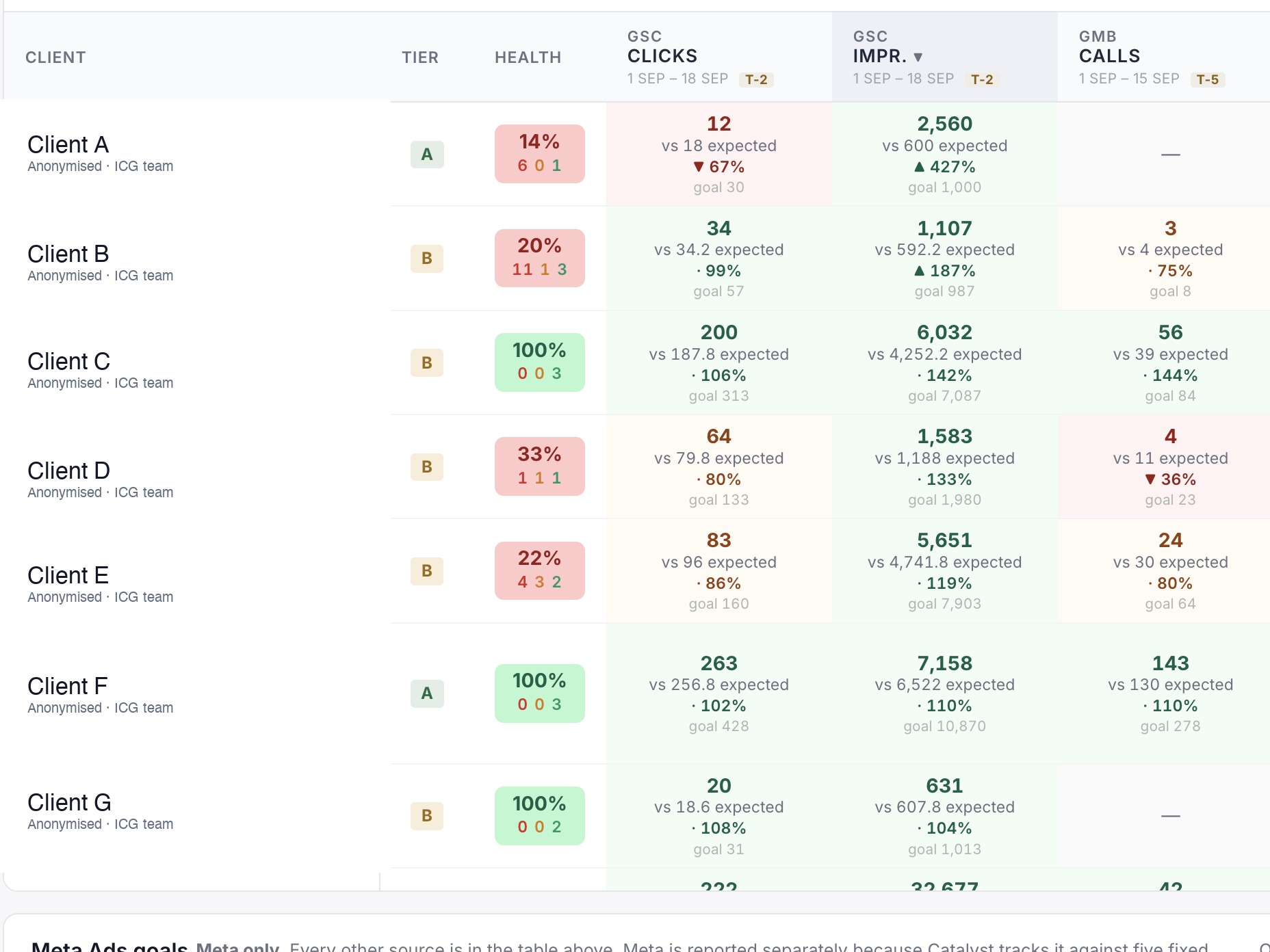
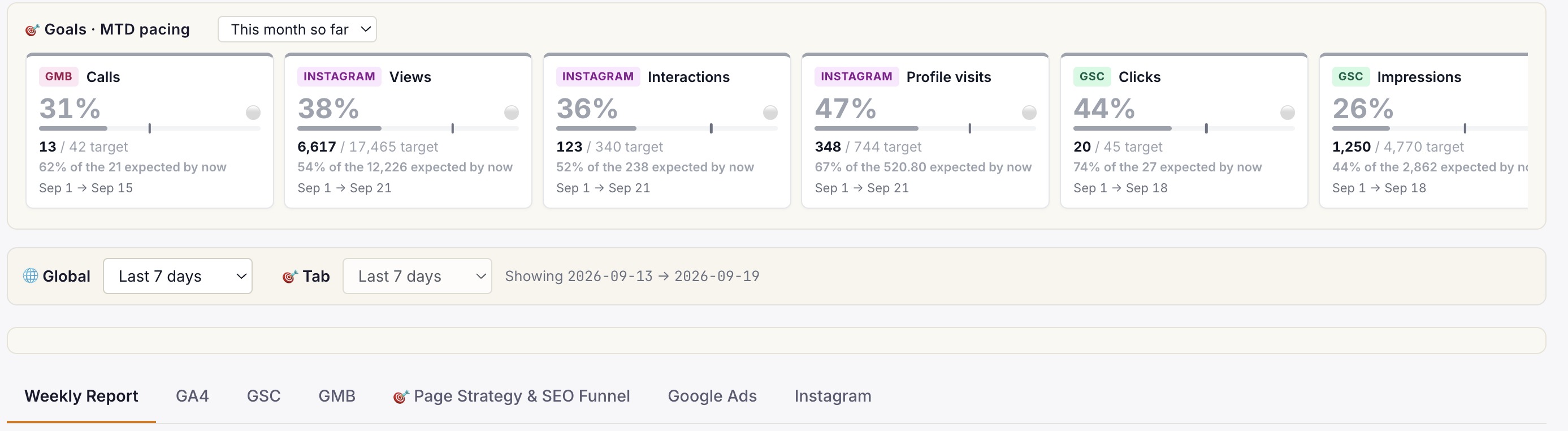
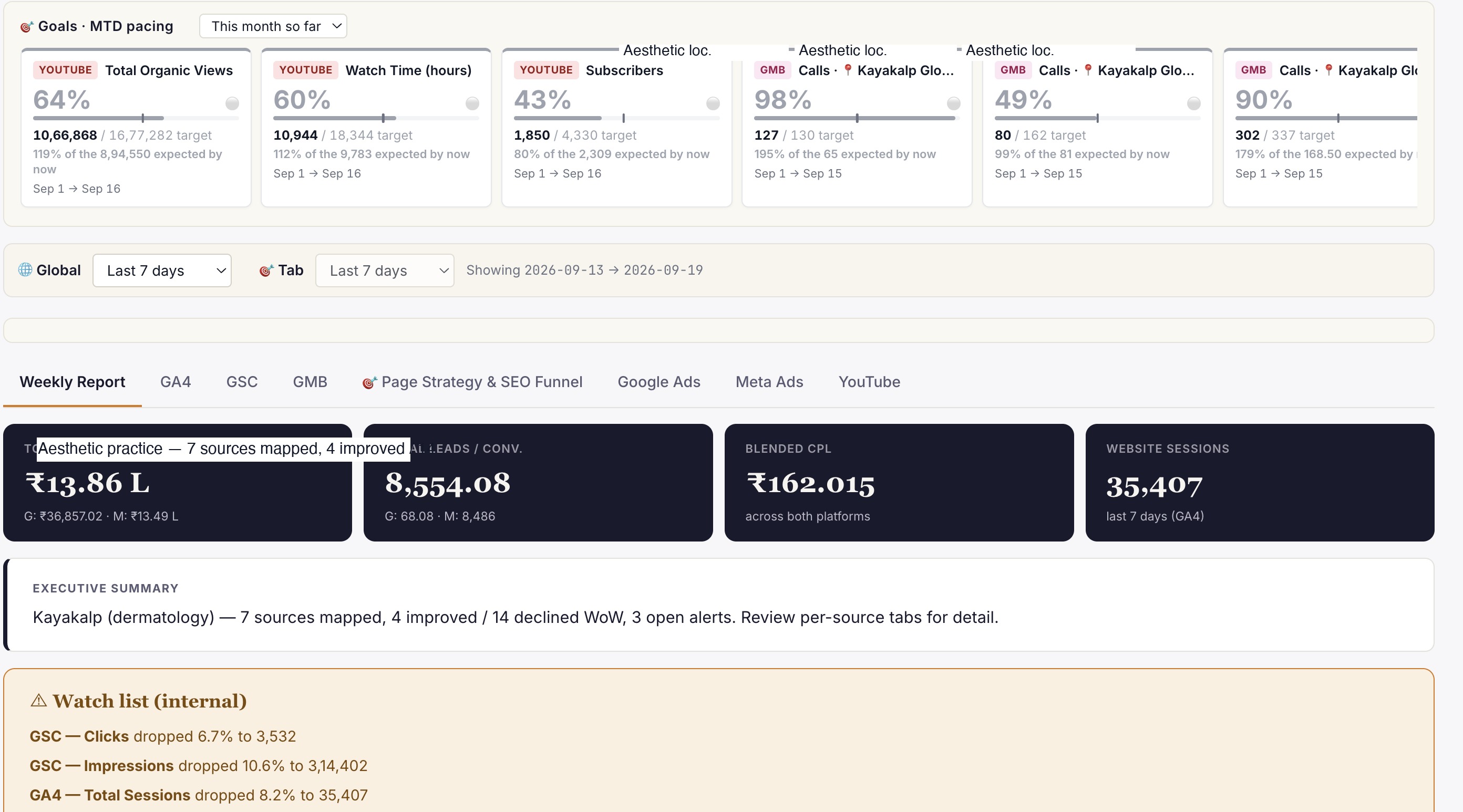
Live client dashboard. GSC, GA4, Google Ads, Meta Ads, IVR calls in one view. Login anytime, not monthly.
Phoenix
Clinic revenue intelligence over your PMS. Daily action queue: Prevent Loss, Maintain & Engage, Grow Revenue. 46-centre rollout.
Or book a free 30-min audit to see all three in action on your account.
Healthcare brands
that already run on ICG.
A representative slice of the 150+ healthcare brands ICG has delivered for across India. Most engagements remain under NDA.


What ICG clients say · on video.
"Scale up of organic channels and business consulting. ICG has absolute domain authority in their field."
"Working with ICG transformed how we acquire IVF patients in Gurgaon. They understand the fertility journey from inquiry to consult..."
"What Ichelon accomplished — they got all my ideas and worked over 3-4 months to create an amazing, super-customised website."
Need help operationalising this?
Every ICG service is healthcare-only, NMC + DPDP-aware, and built around the patient-research patterns that drive Indian healthcare growth in 2026.
Every practice welcome — packages from ₹20,000/mo.
Goal-linked packages · Fixed retainer + Goal-based Variable Pay · 19-month average client retention — industry-leading.
More from
ICG.
Healthcare AIO is the discipline of getting your clinic or hospital cited inside Google AI Overviews, ChatGPT and Perplexity answers — not j...
Conversational-search advertising places brand messages inside AI chat answers — ChatGPT, Perplexity, Copilot — rather than beside a results...
NABH digital compliance means every claim, image and testimonial your hospital publishes online matches what an accreditation surveyor can v...
Stop guessing.
Book a Diagnostic.
30 minutes. Free. With the AI-powered healthcare-only marketing agency 150+ brands already run on. No slides, no pitch, no hard close.


