


Instagram Reporting for Clients — How Agencies Report Without Slides
Why healthcare marketing agencies are moving off monthly Instagram slide decks onto shareable live report URLs — and what the new default report should contain.
No pitch. Written root-cause diagnosis. AI-powered, healthcare only.
Direct answer
Why healthcare marketing agencies are moving off monthly Instagram slide decks onto shareable live report URLs — and what the new default report should contain.
TL;DR
The monthly Instagram reporting slide deck is the single most defended and least useful artefact in a healthcare marketing agency's workflow. Every agency we have audited builds them, every clinic founder claims to want them, and almost nobody re-reads them after the meeting ends. This piece is about what to build instead — the report format that ICG's Prism Pulse — our Instagram analytics and reporting console for healthcare — was designed around, and why the shareable live report URL is quietly replacing PowerPoint across the agencies we work with.
This is a B2B piece for account managers, agency owners and in-house clinic marketing leads. The pain we are addressing is the 40-to-90 minutes per client per month you currently spend assembling screenshots, and the strategic conversation those minutes are stealing from your Friday.
Why slide decks became the default (and why they shouldn't be)
Slide decks became the default agency reporting artefact for one honest reason: they let account managers feel like they had done work. A 22-slide monthly deck with screenshots, charts, and a summary slide is the visible output that justifies the retainer, and no clinic founder was going to complain about receiving too much detail. The problem is not that decks are bad — it is that decks are the wrong artefact for the job. They optimise for volume of output rather than clarity of story, and they hide the two or three things the account actually needs to change next month inside 20 slides of context.
The other reason decks became default is that Meta Business Suite has no shareable-report layer. If you want to give a client a monthly view, you have to export screenshots and manually assemble them somewhere. Slides became the container by default, not by design. Once Prism Pulse holds the same data with a shareable URL as a first-class artefact, the deck stops being necessary and starts being a liability — the time it eats is the time you cannot spend on strategy.
The four things a monthly Instagram report needs — and nothing else
The best client-facing monthly reports we have seen across 30+ healthcare accounts contain four things, in this order.
First, the four KPIs the client actually cares about — reach, interactions, saves, and enquiries — held against the previous month with a direction arrow. Not 12 KPIs. Not the full impression breakdown. Four numbers, big, at the top.
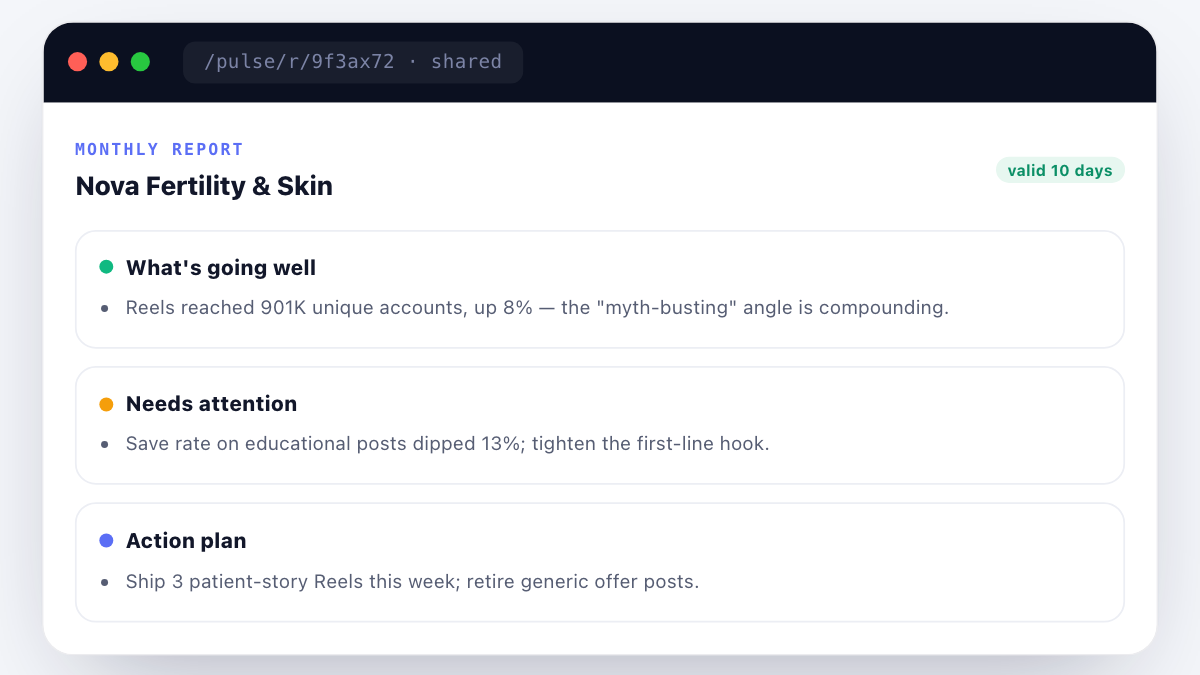
Second, the three plain-English callouts: what's going well, what needs attention, and the action plan for next month. Each callout is one to three sentences. The action plan is specific — "ship three patient-story Reels this week; retire generic offer posts" — not vague — "continue to iterate on high-performing formats."
Third, the top three posts by the KPI that matters (usually reach for a growing account, enquiries for a mature account), with a one-line note on why each one worked. This teaches the client what your team is looking for and closes the loop between the strategy meeting and the output.
Fourth, the format mix for the month against the previous month — Reels, Feed, Stories share of published output — with a note if the mix is shifting deliberately. This is where the strategic conversation lives.
That is the entire report. If it takes more than one screen to scroll through, the report is doing too much. If it takes less than 90 seconds to skim, the report is doing too little. The middle ground is the goal.
What to leave out of the client report — even when the client asks
Clinic founders occasionally ask for things that do not belong in the monthly report. Handle these gracefully.
Do not include follower count as a primary KPI. Follower count is a vanity number that has been increasingly gameable and is a lagging indicator of everything else. Reach is a better proxy for audience size, and enquiries is a better proxy for value. If the founder insists on seeing followers, put it as a secondary number in a footnote, not in the headline.
Do not include full post-by-post tables. Twenty-two posts × 12 metrics is a spreadsheet, not a report. The account team should be looking at that view inside Prism Pulse; the client sees the top three and the aggregate.
Do not include impressions unless you can explain the delta from reach in one line. Impressions is a legitimate metric for creative-fatigue analysis, but on a monthly client report it invites the wrong question ("why is impressions higher than reach?") and derails the meeting.
How the shareable URL changes the client relationship
Once the client-facing report is a URL rather than a slide deck, three things change about the relationship. First, the client can re-read the report between meetings without asking you for a copy — the URL is always live, always current, always shareable. Second, the client can forward the URL to their director or board without you rebuilding the story for a different audience. Third, the account team stops thinking of the report as a Friday-afternoon deliverable and starts thinking of it as a living artefact that reflects the account's state at any moment.
The URL also creates a subtle behavioural change on the client side. Founders who used to skim the deck once and file it start re-visiting the URL mid-month, especially the week before the next review. This is a good thing — it means the report is doing its job.
The 45-minute monthly review meeting agenda
Once the report is a URL and the client has already skimmed it, the monthly review changes shape. Instead of walking through 22 slides in 40 minutes, the meeting looks like this.
- Four minutes — the account lead opens the URL, walks through the four headline KPIs, and highlights the three callouts.
- Ten minutes — the two most important callouts, one about what's working and one about what needs attention. The client asks questions. The account lead answers with data from the console if needed.
- Twenty-five minutes — the strategy conversation for next month. What is the pillar weight shifting to. Which patient stories are we chasing. What is the ad-creative pipeline against the organic pipeline. This is where the value lives.
- Six minutes — action items, owner, deadlines, note in the CRM.
Forty-five minutes, 55% of which is future-facing strategy. Contrast that with the old shape — 40 minutes reviewing screenshots, 5 minutes of "any questions?", and the strategy conversation punted to the next call that never quite happens.
Where the reporting layer fits in the broader stack
Prism Pulse handles the Instagram reporting layer for healthcare agencies. For agencies also reporting on the Google Business Profile layer — where the same problem exists (native GBP Insights is fine, GMB monthly reports don't exist) — ICG's Angryturtle handles the same shareable-report pattern for local SEO. For agencies also tracking competitor Meta Ads activity as part of the monthly client conversation, our Prism Spy tool handles that layer separately. And the Prism Pulse product page has the full feature list, pricing bands and connect-your-account flow if you want to try it before the monthly review meeting.
Frequently asked questions
 Meta Catalyst IQ Creative Scoring Matrix ranking every Meta ad creative by hook strength, proof density, offer clarity and CTA — with money-wastage column in rupees" width="1200" height="675" loading="lazy" decoding="async" style="width:100%;height:auto;display:block;">
Want to see Prism Pulse on your own Instagram account? Book a 20-min walkthrough →
Book a free Meta ads account audit.
Raman Soni's team pulls your account, checks CAPI/EMQ, reviews creative for NMC compliance, and shows where CPQL is leaking. 45 minutes, actionable output.
Questions readers ask
about this topic.
The three platforms
behind every ICG engagement.
Beacon
CAPI middleware that fixes Event Match Quality, translates CRM statuses to Meta-standard events, dedups across channels.
Agency OS
Live client dashboard. GSC, GA4, Google Ads, Meta Ads, IVR calls in one view. Login anytime, not monthly.
Phoenix
Clinic revenue intelligence over your PMS. Daily action queue: Prevent Loss, Maintain & Engage, Grow Revenue. 46-centre rollout.
Or book a free 30-min audit to see all three in action on your account.
Healthcare brands
that already run on ICG.
A representative slice of the 150+ healthcare brands ICG has delivered for across India. Most engagements remain under NDA.


What ICG clients say · on video.
"Scale up of organic channels and business consulting. ICG has absolute domain authority in their field."
"Working with ICG transformed how we acquire IVF patients in Gurgaon. They understand the fertility journey from inquiry to consult..."
"What Ichelon accomplished — they got all my ideas and worked over 3-4 months to create an amazing, super-customised website."
Need help operationalising this?
Every ICG service is healthcare-only, NMC + DPDP-aware, and built around the patient-research patterns that drive Indian healthcare growth in 2026.
More from
ICG.
Healthcare AIO is the discipline of getting your clinic or hospital cited inside Google AI Overviews, ChatGPT and Perplexity answers — not j...
Conversational-search advertising places brand messages inside AI chat answers — ChatGPT, Perplexity, Copilot — rather than beside a results...
NABH digital compliance means every claim, image and testimonial your hospital publishes online matches what an accreditation surveyor can v...
Stop guessing.
Book a Diagnostic.
30 minutes. Free. With the AI-powered healthcare-only marketing agency 150+ brands already run on. No slides, no pitch, no hard close.


