


Single-drug adverse event intelligence.
Spot signals before they escalate.
Raw adverse event data is voluminous, unstructured, and time-consuming to analyse. Pharos Vigil compresses safety analysis from days to minutes — without sacrificing rigour.
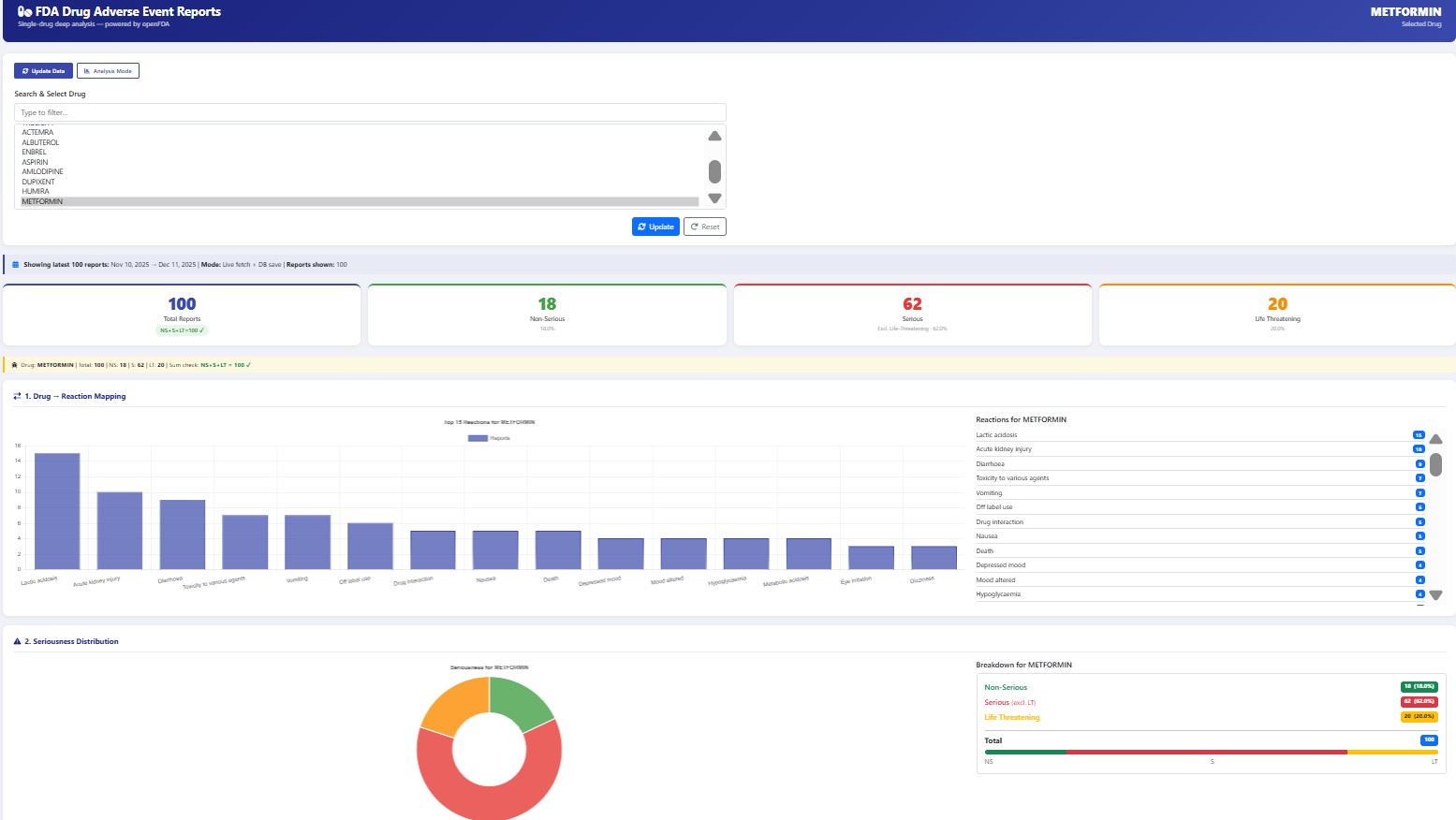
Pharos Vigil · Single-drug adverse event intelligence dashboard.
Why safety analysis
often arrives too late.
Raw adverse event data is voluminous, unstructured, and time-consuming to analyse. Safety teams spend hours — sometimes days — building reports that answer the same recurring question: "What is happening with Drug X right now?" By the time the analysis is complete, the window for early signal identification has often closed. Vigil compresses that analysis to minutes.
Three capabilities. One tool.
Deep Single-Drug Analysis
Focused exploration of adverse event reports for any selected drug within a defined date range. Uncovers safety trends specific to monitoring priorities without requiring database expertise.
On-Demand Data Refresh
Live data updates ensure safety analysts always work with the most current adverse event reports. No waiting for monthly reports. Signal detection happens when signals emerge — not when the calendar permits.
Flexible Analysis Modes
Multiple analysis options including database-stored views. Cross-examine historical and newly fetched reports for comprehensive signal monitoring across the product's safety history.
What the engagement
actually looks like.
How Pharos Vigil compresses safety-signal analysis from days to minutes
A typical Vigil engagement begins with the safety-team head facing one of two problems: (1) a sudden uptick in spontaneous reporting for a specific product (the marketing team's promotional cycle, a competitor's withdrawal, or a media event has caused a spike) — and the safety team needs an immediate analysis; or (2) a recurring monthly safety review cycle that consumes 60–120 analyst-hours per drug. Vigil solves both.
Single-drug deep analysis. The analyst selects the product, the date range, and the report-source set (spontaneous, literature, clinical-trial, post-marketing study, registry). Vigil produces a structured visualisation: adverse-event distribution by MedDRA SOC (System Organ Class) and PT (Preferred Term), seriousness breakdown, reporter qualification breakdown, geographic distribution, and signal-strength metrics (PRR, ROR, IC025 — Proportional Reporting Ratio, Reporting Odds Ratio, Bayesian Information Component lower 95% CI). The full picture is on-screen in minutes, not days.
On-demand data refresh. Vigil ingests the latest case data on demand — no monthly batch wait. Signal detection happens when signals emerge, not when the calendar permits. This is decisive when a regulatory query lands and the team has 5 working days to respond.
Flexible analysis modes. Database-stored views, ad-hoc analyses, comparison views (e.g., compare current 90-day window against same window last year), and cross-product overlays (compare Drug A's safety profile against a benchmark Drug B) — all available without database expertise.
Regulatory framework
Vigil aligns with EU GVP Module IX (signal management), the WHO-UMC Causality Assessment Criteria, the EU EMA Guideline on Statistical Methodology for Evaluation of Signals in Spontaneous Reports, and the US FDA Safety First initiative for postmarketing surveillance.
Outcome targets
(1) Signal-analysis turnaround time — typical reduction from 2–4 days to 30–90 minutes per single-drug analysis; (2) Regulatory-query-response timeliness — 100% on-time responses for safety queries with 5-working-day deadlines; (3) Signal-detection latency — measurable improvement in time from earliest reporting cluster to internal signal-review trigger.
How Pharos Vigil connects
to the rest of Pharos.
Vigil surfaces the signal. Scout supplies the corresponding literature evidence. Deploy translates the signal frequency into a resource plan.
Built for specific roles.
Nine modules. One intelligence layer.
Built for the specific frictions of pharma.
Every pharmacovigilance engagement ICG runs is powered by Scout, Vigil, and Deploy — three tools built for the specific frictions of PV operations that no off-the-shelf tool solves.
Explore the full Pharos platform →Every ICG pharma engagement runs on some combination of these nine modules. The pilot engagement determines which ones are active from Day 1.
Start a pilot project →
Led by a pharma specialist.
IIT BHU-founded leadership team.
Every ICG pharma engagement is led personally by Aditi Tripathi — M.Pharm, IIT BHU — with Abhash, Deep and Rohit (Co-Founding Team) bringing the scientific rigour, delivery architecture and commercial lens built across 8+ years. IIT BHU pharmaceutical engineers at every level of the engagement.

100+ specialists. One process. Every deliverable in-house. Gurgaon, since 2018.

Abhash Kumar
Strategy Lead · IIT BHU + IIM Bangalore
Leads scientific strategy and quality governance. Sets the standard for scientific rigour across every engagement.
Profile →
Deep Das
Operations Lead · IIT BHU (B.Tech + M.Tech)
Owns the AI-powered delivery system — the multi-tenant operations layer that runs every pharma engagement on time and on spec.
Profile →
Rohit Gupta
Business & Growth Lead · IIT BHU + IIM Rohtak
Pharma engineer who owns business growth and the commercial lens connecting science to prescription outcomes.
Profile →
Aditi Tripathi
IIT BHU · M.Pharm
Aditi leads every pharma engagement end to end — from scoping the scientific writing architecture to governing quality across delivery. Her M.Pharm from IIT BHU means she doesn't need the science explained to her. "She explains it to everyone else."
See Pharos Vigil live.
30-minute demo. No commitment.
The demo walks through drug ae visualization on real (anonymised) pharma data. You see exactly how the tool fits the engagement before any commercial conversation.
