


PV staffing decisions you can defend.
With data. Not intuition.
Pharmacovigilance teams managing large drug portfolios allocate resources based on habit, seniority, or subjective assessment of "busyness." Pharos Deploy replaces all of it with objective, traceable risk-tier data.
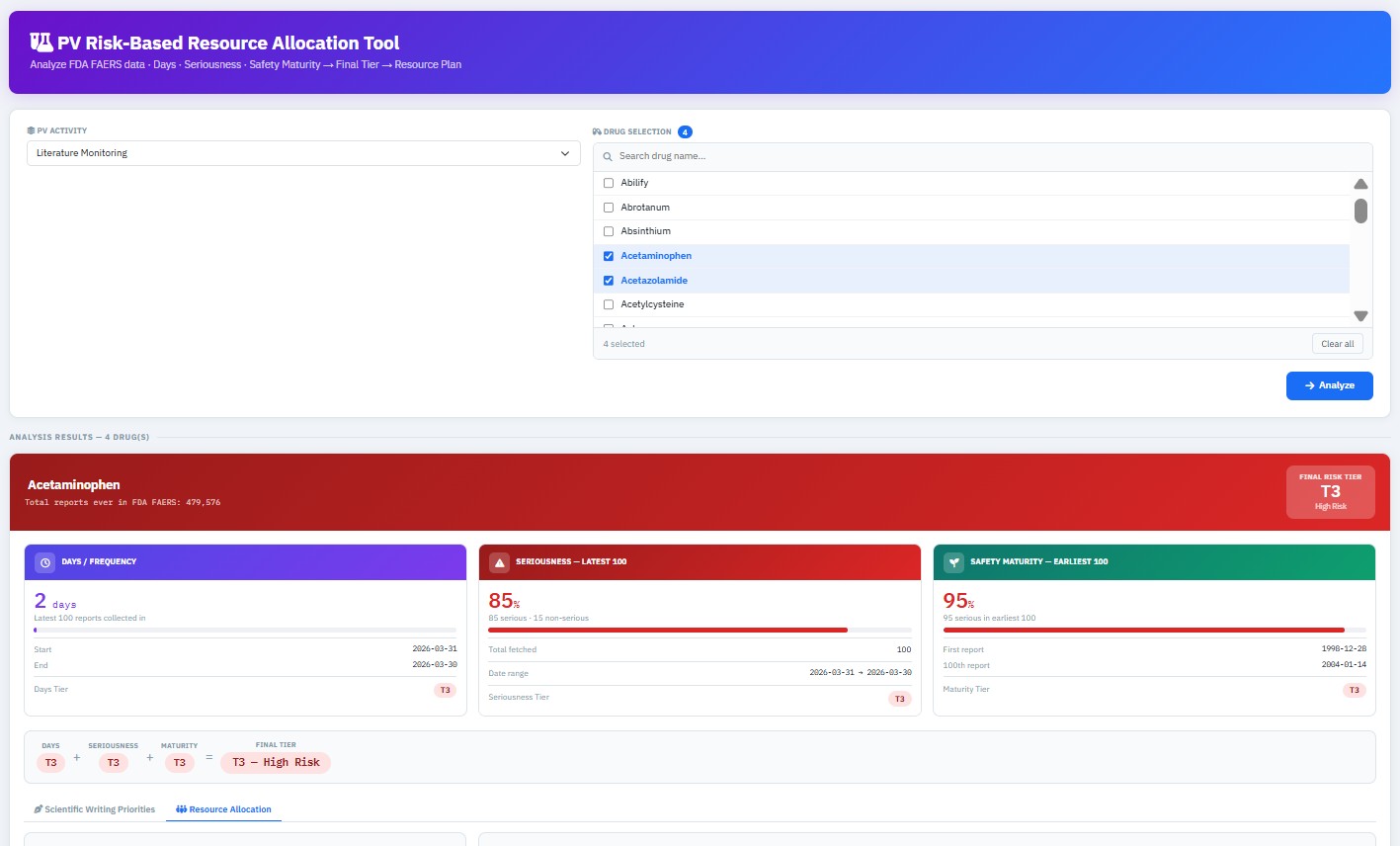
Pharos Deploy · Risk-based drug tiering and defensible PV staffing.
Why PV resourcing
fails at inspection.
Pharmacovigilance teams managing large drug portfolios allocate resources based on habit, seniority, or subjective assessment of "busyness." The result is quality gaps on high-risk drugs, underutilisation on low-risk products, and an inability to answer the single most important question at a PV inspection: "Why is this writer on this drug?" Deploy answers that question with objective, traceable data.
Three capabilities. One tool.
Objective Drug Tiering Using Signal Frequency & Seriousness
Computes reporting speed and seriousness rate per drug from adverse event data to assign a Final Risk Tier. Replaces subjective judgement with consistent, data-backed classification that survives inspector scrutiny.
Activity-Level Resource Allocation by Writer Skill Mix
For each tiered drug and PV activity, generates a resource plan by writer level specifying hours per day and monthly commitment. Appropriate expertise matched to each task. Eliminates over- and under-allocation.
Capacity Planning Output for Quality-Driven Delivery
Scientific Writing Priority cards showing deliverable type, required skill mix, and hour commitments. Team leads get a ready-to-use capacity plan that supports consistent quality delivery across the full portfolio.
What the engagement
actually looks like.
How Pharos Deploy operationalises PV resource allocation
A typical Deploy engagement begins with a PV head asking: "Why is this writer on this drug?" Most PV teams cannot answer that question with data. Deploy makes the answer data-backed and inspection-defensible.
Phase 1 (weeks 1–3) — Drug tiering baseline. Deploy computes objective drug tiering using two signal-frequency dimensions: reporting speed (cases per day from sources including spontaneous reports, literature, regulatory databases, and ongoing studies) and seriousness rate (serious adverse event proportion of total cases). The output is a Final Risk Tier per drug, replacing subjective "high/medium/low" judgments with quantifiable classification.
Phase 2 (weeks 4–8) — Activity-level resource allocation. For each tiered drug, Deploy generates a resource plan specifying writer skill level (junior/mid-senior/senior/medical-reviewer), activity type (case-narrative writing, signal review, PSUR/PBRER section authoring, literature-monitoring screening), hours per day, and monthly commitment. The plan is exportable as a deployment matrix the PV head can present at any inspection.
Phase 3 (weeks 8+) — Capacity planning and over/under-allocation correction. Deploy continuously monitors actual utilisation against allocated capacity, surfacing over-allocation (writer burnout risk) and under-allocation (quality gap risk). Team leads see in real-time which drugs are at risk of quality slippage and which are over-resourced.
Regulatory framework
Deploy aligns with EU GVP Module I (PV system governance) and Module II (PSMF — pharmacovigilance system master file), and the US FDA inspection framework that increasingly probes PV resourcing as a quality system attribute. The Deploy output is direct input to PSMF resource sections.
Outcome targets
(1) Resource-allocation inspection-defensibility — measurable via GVP I/II self-assessment; (2) over-allocation / under-allocation correction — typically 25–40% of writer-days reallocated within 90 days; (3) PV-quality-event reduction — measurable downstream impact on missed-case timelines, late submissions, and QC findings.
How Pharos Deploy connects
to the rest of Pharos.
Deploy converts safety signal data into a defensible resource plan. Scout supplies the literature workload. Vigil supplies the signal frequency that drives drug tiering.
Built for specific roles.
Nine modules. One intelligence layer.
Built for the specific frictions of pharma.
Every pharmacovigilance engagement ICG runs is powered by Scout, Vigil, and Deploy — three tools built for the specific frictions of PV operations that no off-the-shelf tool solves.
Explore the full Pharos platform →Every ICG pharma engagement runs on some combination of these nine modules. The pilot engagement determines which ones are active from Day 1.
Start a pilot project →
Led by a pharma specialist.
IIT BHU-founded leadership team.
Every ICG pharma engagement is led personally by Aditi Tripathi — M.Pharm, IIT BHU — with Abhash, Deep and Rohit (Co-Founding Team) bringing the scientific rigour, delivery architecture and commercial lens built across 8+ years. IIT BHU pharmaceutical engineers at every level of the engagement.

100+ specialists. One process. Every deliverable in-house. Gurgaon, since 2018.

Abhash Kumar
Strategy Lead · IIT BHU + IIM Bangalore
Leads scientific strategy and quality governance. Sets the standard for scientific rigour across every engagement.
Profile →
Deep Das
Operations Lead · IIT BHU (B.Tech + M.Tech)
Owns the AI-powered delivery system — the multi-tenant operations layer that runs every pharma engagement on time and on spec.
Profile →
Rohit Gupta
Business & Growth Lead · IIT BHU + IIM Rohtak
Pharma engineer who owns business growth and the commercial lens connecting science to prescription outcomes.
Profile →
Aditi Tripathi
IIT BHU · M.Pharm
Aditi leads every pharma engagement end to end — from scoping the scientific writing architecture to governing quality across delivery. Her M.Pharm from IIT BHU means she doesn't need the science explained to her. "She explains it to everyone else."
See Pharos Deploy live.
30-minute demo. No commitment.
The demo walks through pv resource allocation on real (anonymised) pharma data. You see exactly how the tool fits the engagement before any commercial conversation.
