


Literature monitoring that's audit-ready.
Not audit-defensible — audit-ready.
Periodic literature monitoring for pharmacovigilance requires consistent, reproducible, and documented search processes. Most teams rely on manual approaches that fail at inspection. Pharos Scout was built to make the answer to "Can you reproduce this search exactly?" — yes.
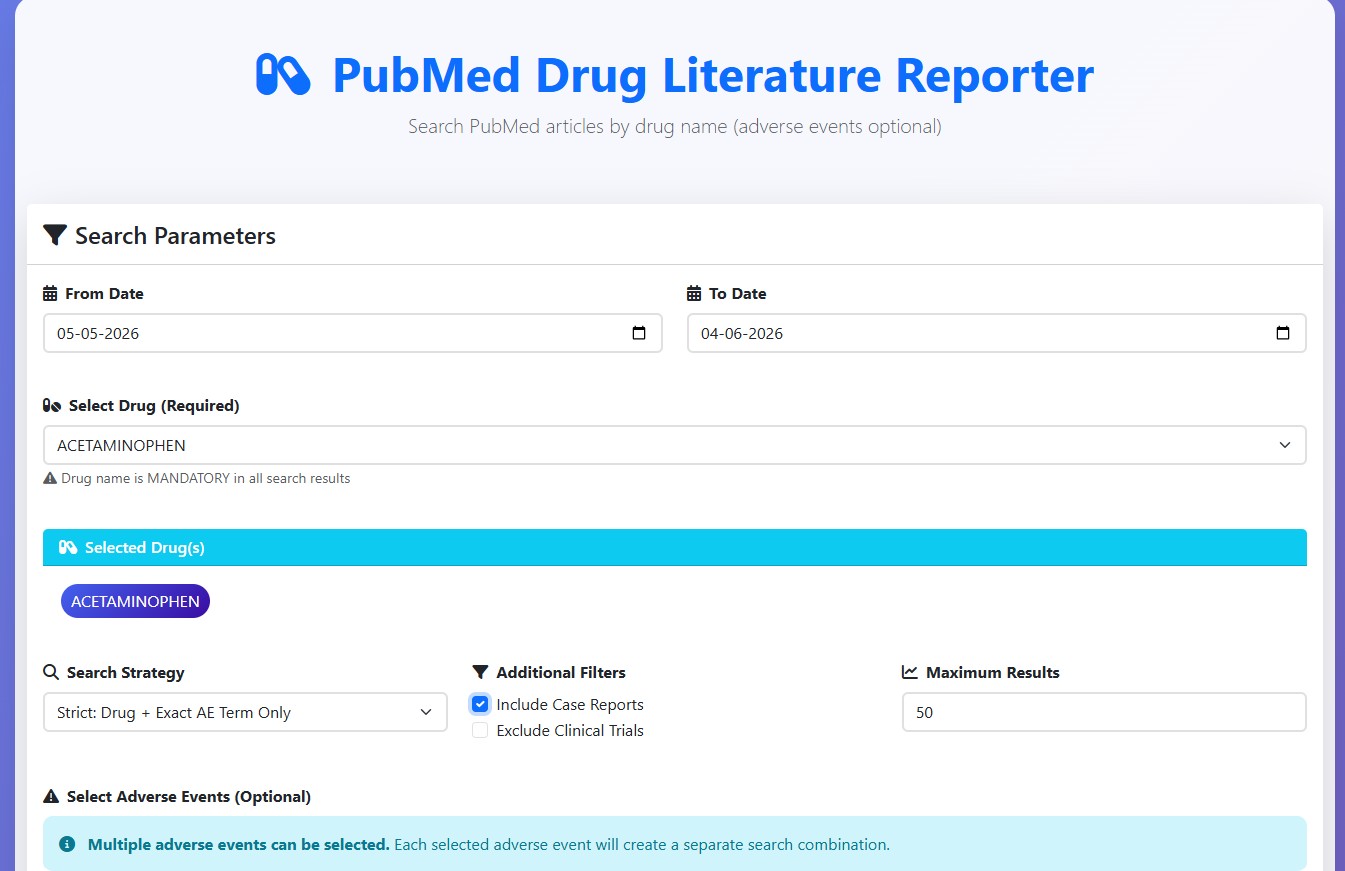
Pharos Scout · Audit-ready literature surveillance for pharmacovigilance.
The audit problem
with manual literature monitoring.
Periodic literature monitoring for pharmacovigilance requires consistent, reproducible, and documented search processes. Most teams rely on manual approaches: a writer constructs a search string from memory, runs it in PubMed, exports results to a spreadsheet, deduplicates manually. Six months later, an inspector asks: "Can you reproduce this search exactly?" The honest answer is usually no. Scout was built to make the honest answer yes.
Three capabilities. One tool.
Validated MeSH + TIAB Query Builder
Auto-generates validated PubMed search strings using MeSH headings and comprehensive drug spelling variants in TIAB fields. Every search string documented. Every variant captured. Every result reproducible from the same starting parameters.
Consolidated Evidence Table with AE-Wise Signal Analysis
All retrieved articles de-duplicated and presented in a consolidated evidence table tagged by study type, adverse event, and evidence score. Instantly surfaces which AEs have active literature signals requiring narrative attention.
Scientific Narrative Prioritisation Framework
Per-AE article view with evidence scoring, study type classification, and abstract-level triage. Enables medical writers and PV scientists to systematically prioritise which articles require full review and narrative documentation.
What the engagement
actually looks like.
How Pharos Scout deploys inside a PV (pharmacovigilance) team
A typical Scout deployment is triggered by one of three events: a new EU GVP IX inspection, a PSUR/PADER cycle that consumed unsustainable analyst-hours, or a CAPA (Corrective and Preventive Action) commitment to "improve literature monitoring reproducibility." The deployment runs through three phases.
Phase 1 (weeks 1–4) — Baseline reproducibility audit. Scout audits the team's existing literature monitoring SOPs for reproducibility. The audit answers: can two independent analysts following the SOP arrive at the same article list for the same search window? Most teams discover the answer is no — search strings drift, MeSH terms are inconsistent, drug-name variants are missed. The audit produces a gap report that becomes the basis for a CAPA-aligned remediation plan.
Phase 2 (weeks 5–12) — Validated search infrastructure. Scout deploys a validated MeSH-plus-TIAB query builder per drug. Every search string is documented, version-controlled, and reproducible from a stored parameter set. The team's per-drug search strings become regulatory assets — they can be produced on demand at inspection.
Phase 3 (weeks 12+) — Continuous monitoring + signal review cycle. Scout runs the validated searches on a defined cadence (typically weekly or fortnightly), produces consolidated evidence tables tagged by adverse event and study type, and prioritises articles for full-text review by signal severity. Analyst time on literature monitoring typically drops 50–70% while audit-defensibility improves.
Regulatory framework
Scout operates against the EU EMA Guideline on Good Pharmacovigilance Practices Module IX (GVP IX) for signal management, the US FDA 21 CFR 314.80 PADER framework, and the WHO-UMC Causality Assessment Criteria. The output is structured for direct inclusion in PSURs, PBRERs, and signal-detection reports.
Outcome targets
A 12-month Scout engagement is benchmarked against: (1) analyst-hours saved — typically 50–70% reduction in literature monitoring time; (2) inspection-readiness score — measured against GVP IX reproducibility criteria, target 95%+ by month 6; (3) signal-detection latency — typical reduction from 4–8 weeks to 5–10 days for safety-relevant articles.
How Pharos Scout connects
to the rest of Pharos.
Scout produces the audit-ready literature evidence. Vigil visualises the corresponding adverse-event data. Deploy translates the workload into a defensible resource plan.
Built for specific roles.
Nine modules. One intelligence layer.
Built for the specific frictions of pharma.
Every pharmacovigilance engagement ICG runs is powered by Scout, Vigil, and Deploy — three tools built for the specific frictions of PV operations that no off-the-shelf tool solves.
Explore the full Pharos platform →Every ICG pharma engagement runs on some combination of these nine modules. The pilot engagement determines which ones are active from Day 1.
Start a pilot project →
Led by a pharma specialist.
IIT BHU-founded leadership team.
Every ICG pharma engagement is led personally by Aditi Tripathi — M.Pharm, IIT BHU — with Abhash, Deep and Rohit (Co-Founding Team) bringing the scientific rigour, delivery architecture and commercial lens built across 8+ years. IIT BHU pharmaceutical engineers at every level of the engagement.

100+ specialists. One process. Every deliverable in-house. Gurgaon, since 2018.

Abhash Kumar
Strategy Lead · IIT BHU + IIM Bangalore
Leads scientific strategy and quality governance. Sets the standard for scientific rigour across every engagement.
Profile →
Deep Das
Operations Lead · IIT BHU (B.Tech + M.Tech)
Owns the AI-powered delivery system — the multi-tenant operations layer that runs every pharma engagement on time and on spec.
Profile →
Rohit Gupta
Business & Growth Lead · IIT BHU + IIM Rohtak
Pharma engineer who owns business growth and the commercial lens connecting science to prescription outcomes.
Profile →
Aditi Tripathi
IIT BHU · M.Pharm
Aditi leads every pharma engagement end to end — from scoping the scientific writing architecture to governing quality across delivery. Her M.Pharm from IIT BHU means she doesn't need the science explained to her. "She explains it to everyone else."
See Pharos Scout live.
30-minute demo. No commitment.
The demo walks through literature monitoring on real (anonymised) pharma data. You see exactly how the tool fits the engagement before any commercial conversation.
