


AI-guided scientific writing.
From topic selection to submission-ready manuscript.
Most scientific manuscripts fail at three points before they reach a journal: weak topic selection, mismatched journal targeting, and inconsistent writing governance. Pharos Scribe was built to eliminate all three.
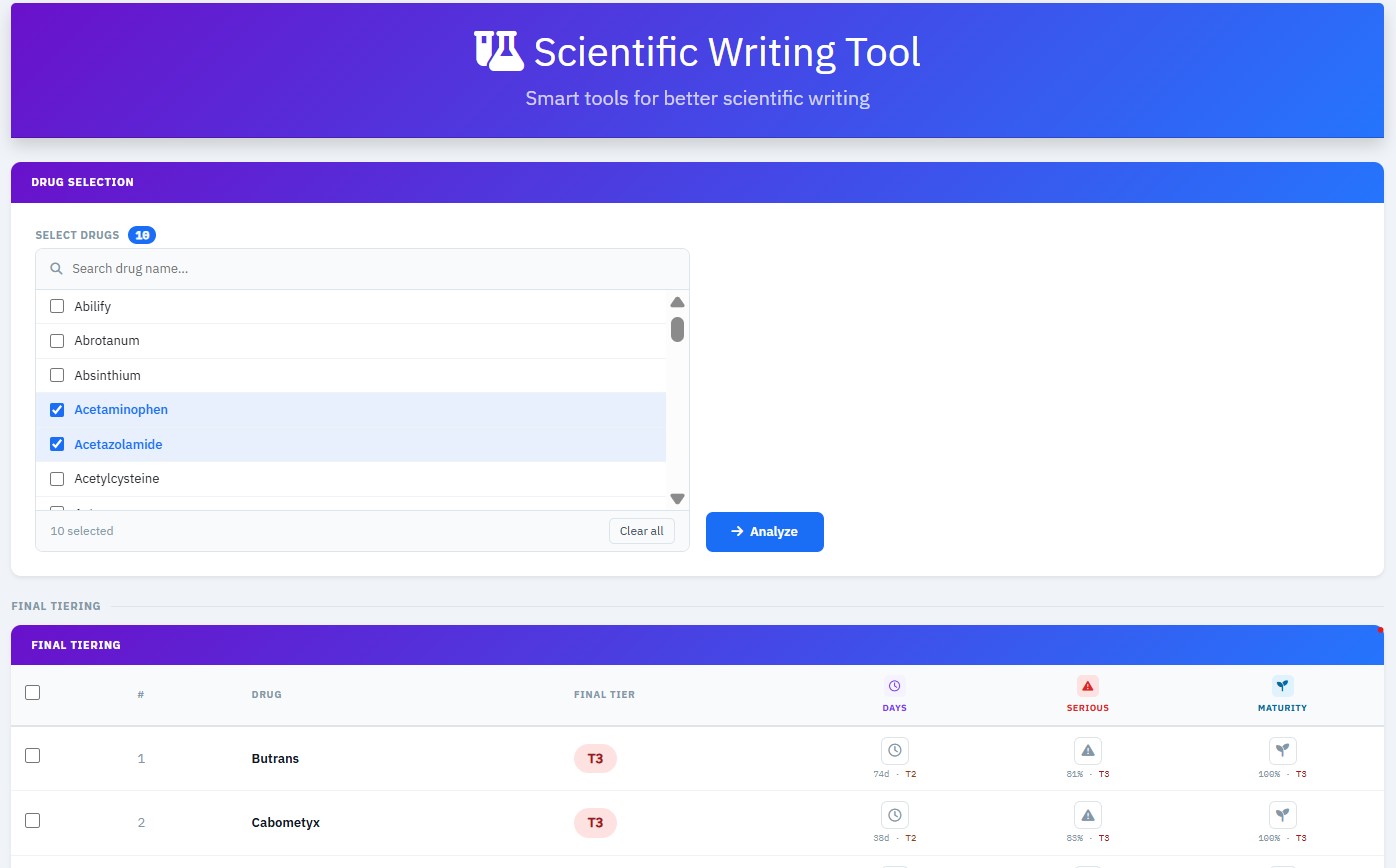
Pharos Scribe · From topic selection to submission-ready manuscript.
Three failures
that desk-reject manuscripts.
Scientific manuscript writing fails at three points before it even reaches a journal. Topic selection without evidence mapping leads to manuscripts that don't fill a real gap. Journal selection based on impact factor alone leads to scope mismatches and desk rejections. Writing without governance leads to inconsistencies between methods and results that only appear in reviewer comments — 6 months after submission. Pharos Scribe was built to eliminate all three.
Three capabilities. One tool.
AI-Suggested Topic Selection & Journal Fit Strategy
The tool guides writers through topic identification using AI-suggested themes grounded in published evidence — paired with a journal fit strategy that maps manuscript scope against impact metrics, scope alignment, and acceptance probability. The first submission is the right submission.
Milestone-Based Writing Governance with QC Checkpoints
Structured framework with milestone tracking, version control, change logs, and sequential QC checkpoints for scientific, editorial, and technical accuracy. Every deliverable meets publication-grade standards before it leaves ICG.
Submission Readiness Checklist & Fast Turnaround Tracking
Submission readiness checklist ensures completeness and guideline compliance before finalisation. Fast turnaround tracking enables timely delivery without compromising quality.
What the engagement
actually looks like.
How Pharos Scribe deploys inside a pharma medical-affairs team
A typical Scribe deployment begins with the medical-affairs head identifying a publication backlog — usually 8–24 manuscripts at various stages between concept and submission. The Scribe deployment runs through three phases.
Phase 1 (weeks 1–3) — Audit and re-baseline. Every in-flight manuscript is audited against the Scribe framework: topic-evidence fit (does the manuscript fill a documented gap in the published literature?), journal-fit match (is the target journal's scope, impact metric, and reviewer profile aligned with the manuscript's scientific contribution?), and writing-governance status (are method, results, discussion, and conclusion sections internally consistent?). The audit produces a triage matrix: which manuscripts are ready to submit, which need scope adjustment, which need a different target journal, and which should be paused.
Phase 2 (weeks 4–16) — Submission cadence. Scribe drives a structured submission cadence — typically 2–4 manuscripts per month for a mid-sized medical-affairs team. Each manuscript moves through milestone-based QC checkpoints (scientific accuracy review at 60% draft, editorial review at 90% draft, technical/formatting review at 100% draft) before final submission. The cadence is documented, repeatable, and inspection-defensible.
Phase 3 (weeks 16+) — Publication ROI tracking. Once manuscripts begin landing in journals, Scribe tracks downstream metrics: citation accumulation, journal-club uptake, prescriber awareness lift (measured via paired KOL surveys), and competitive positioning (which competitor publications were referenced in your own paper's literature review). The publication ROI loop closes — the same team that produced the publication can see its commercial and scientific impact within 18 months.
Compliance framework
Scribe operates against ICMJE authorship guidelines, GPP (Good Publication Practice) 2022, the ICH E3 Clinical Study Report structure, and the Pharma-specific UCPMP 2024 promotional-vs-non-promotional content distinction. All manuscripts produced under Scribe governance are auditable against any of these frameworks. The toolkit also encodes the WAME (World Association of Medical Editors) disclosure requirements.
Outcome targets
A 12-month Scribe engagement is benchmarked against three measurable outcomes: (1) publication throughput — typically 18–36 manuscripts published or in-press per year for a mid-sized medical-affairs team, up from 4–8 in pre-engagement baseline; (2) first-submission acceptance rate — typically 50–65% (industry baseline: 18–25%), driven by Scribe's journal-fit framework; (3) publication-to-prescriber-awareness lift — measured via paired KOL surveys at 12 months post-publication.
How Pharos Scribe connects
to the rest of Pharos.
Scribe is the writing engine. Scout feeds it the literature evidence that grounds topic selection. Deploy ensures writer-skill allocation matches the manuscript's scientific complexity.
Built for specific roles.
Nine modules. One intelligence layer.
Built for the specific frictions of pharma.
Every pharmacovigilance engagement ICG runs is powered by Scout, Vigil, and Deploy — three tools built for the specific frictions of PV operations that no off-the-shelf tool solves.
Explore the full Pharos platform →Every ICG pharma engagement runs on some combination of these nine modules. The pilot engagement determines which ones are active from Day 1.
Start a pilot project →
Led by a pharma specialist.
IIT BHU-founded leadership team.
Every ICG pharma engagement is led personally by Aditi Tripathi — M.Pharm, IIT BHU — with Abhash, Deep and Rohit (Co-Founding Team) bringing the scientific rigour, delivery architecture and commercial lens built across 8+ years. IIT BHU pharmaceutical engineers at every level of the engagement.

100+ specialists. One process. Every deliverable in-house. Gurgaon, since 2018.

Abhash Kumar
Strategy Lead · IIT BHU + IIM Bangalore
Leads scientific strategy and quality governance. Sets the standard for scientific rigour across every engagement.
Profile →
Deep Das
Operations Lead · IIT BHU (B.Tech + M.Tech)
Owns the AI-powered delivery system — the multi-tenant operations layer that runs every pharma engagement on time and on spec.
Profile →
Rohit Gupta
Business & Growth Lead · IIT BHU + IIM Rohtak
Pharma engineer who owns business growth and the commercial lens connecting science to prescription outcomes.
Profile →
Aditi Tripathi
IIT BHU · M.Pharm
Aditi leads every pharma engagement end to end — from scoping the scientific writing architecture to governing quality across delivery. Her M.Pharm from IIT BHU means she doesn't need the science explained to her. "She explains it to everyone else."
See Pharos Scribe live.
30-minute demo. No commitment.
The demo walks through ai scientific writing on real (anonymised) pharma data. You see exactly how the tool fits the engagement before any commercial conversation.
